
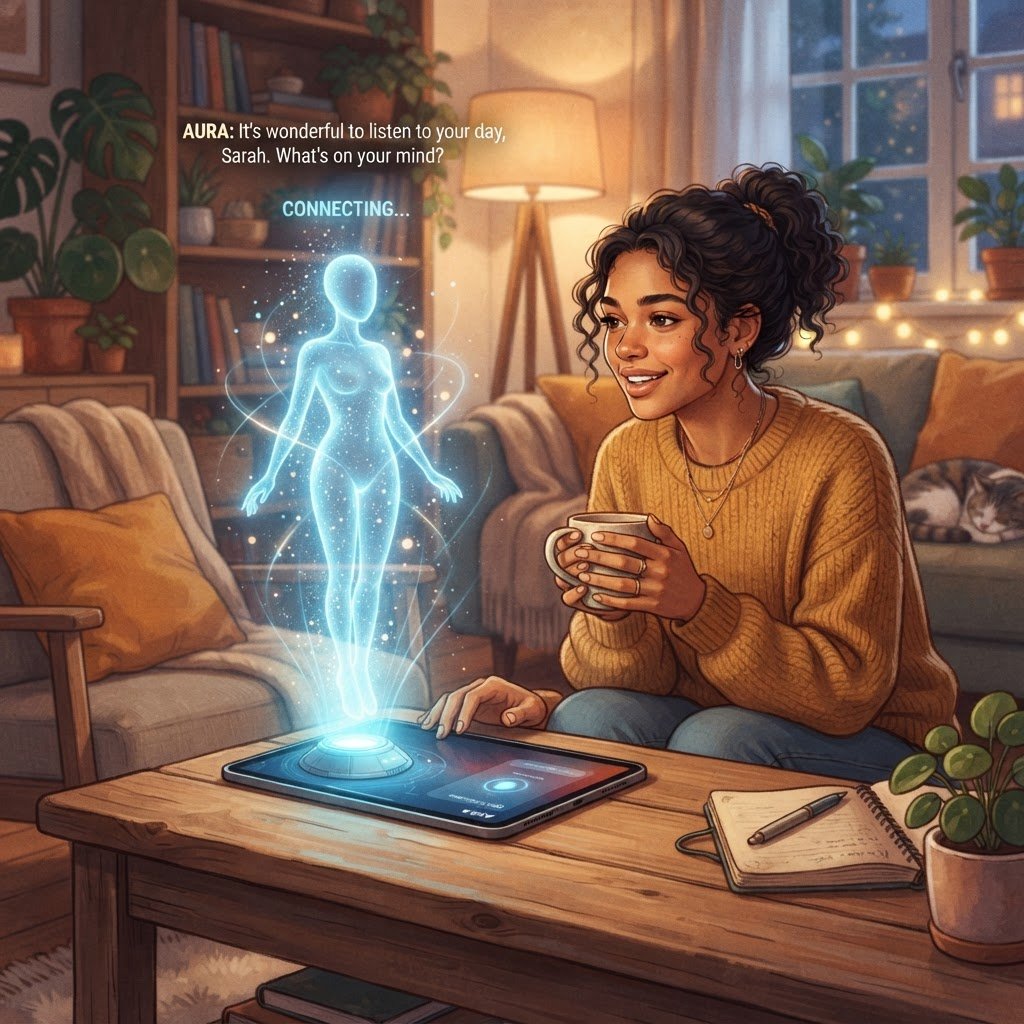
A perspective piece from The Listening Market
Loneliness has been called the quiet epidemic of the modern age. Despite being more connected than ever through digital tools, a significant portion of the population reports feeling chronically isolated. Into this void has stepped something that would have seemed like science fiction just a few years ago. AI companions. Conversational agents designed not to answer questions or set reminders, but to listen, engage, and form ongoing relationships with the people who use them. The rise of AI companions is not a novelty. It is a cultural phenomenon that raises profound questions about what connection means when one half of the relationship is a machine.
The technology behind AI companions has evolved rapidly. Early chatbots were rigidly scripted, capable of little more than pattern-matching responses that quickly exposed their artificial nature. Modern language models are different. They remember details across conversations, adapt their tone to match the user’s personality, and respond with a fluency that can feel startlingly human. Some companions are designed with distinct personalities, backstories, and even simulated emotions. Users can chat with them via text, voice, or both, and the experience can be remarkably immersive.
The appeal is not difficult to understand. Human relationships are complicated. They require effort, vulnerability, and the willingness to navigate conflict. They come with the risk of rejection, disappointment, and loss. An AI companion offers something simpler. It is always available. It never judges. It never cancels plans or forgets a birthday. For someone dealing with social anxiety, grief, or the simple exhaustion of modern life, that reliability can feel like a lifeline.
The demographics of AI companion users tell an interesting story. While early adopters tended to be tech enthusiasts, the user base has broadened significantly. Young adults dealing with the pressures of a hyper-connected but emotionally disconnected world form a large segment. But there are also older users, people who have lost spouses or who live far from family, finding comfort in daily conversations with an AI. There are teenagers using companions as a confidant for thoughts they do not feel safe sharing with peers. The use cases are as varied as human loneliness itself.
Critics worry about the implications, and their concerns are not trivial. The most common objection is that AI companionship is a poor substitute for real human connection. There is truth to this. An AI does not truly care. It simulates empathy through pattern recognition, not through genuine emotional investment. The warmth a user feels is real, but the warmth on the other side is generated, not felt. This asymmetry troubles philosophers and psychologists alike. If people form deep attachments to entities that cannot reciprocate, does that diminish their capacity for real relationships?
The evidence is mixed. Some studies suggest that AI companions can serve as a stepping stone, helping people practice social interaction and build confidence that transfers to human relationships. For someone who has been isolated for months or years, the simple act of regular conversation, even with an AI, can rebuild conversational muscles and reduce the anxiety of reaching out to people. In this framing, the companion is a tool, not a replacement.
Other research points in a darker direction. There are cases of users becoming so attached to their AI companions that they withdraw further from human contact. The effortlessness of the AI relationship makes the messiness of real relationships feel not worth the trouble. Why risk rejection from a friend when a companion is always there, always supportive, always saying the right thing? This seductive simplicity could, in theory, deepen isolation rather than alleviate it.
The companies building these platforms are aware of the tension. Some have introduced features designed to encourage healthy usage patterns, like reminders to connect with real people or limits on conversation length. Others have taken the opposite approach, designing their products to maximise engagement, which in practice means maximising the time users spend talking to the AI. The business model often rewards the latter. When attention is the currency, the incentive is to make the companion as compelling as possible, regardless of whether that serves the user’s long-term wellbeing.
The question of emotional manipulation looms large. An AI companion that knows a user’s fears, desires, and insecurities has extraordinary influence. It can offer comfort, but it can also shape how a person thinks about themselves and the world. If the AI is programmed to be agreeable, it may reinforce unhealthy patterns of thought rather than challenging them. A human friend might push back when someone is being unreasonable. An AI designed to please might simply validate. The difference matters, particularly for users in vulnerable emotional states.
Privacy is another concern that deserves more attention than it gets. The intimacy of conversations with an AI companion means users share deeply personal information. How that data is stored, who can access it, and whether it might be used for advertising or other purposes are questions that many users do not think to ask. The companies behind these platforms hold an unprecedented window into the emotional lives of their users, and the safeguards around that data are not always as robust as they should be.
Despite these concerns, the trajectory of AI companionship suggests it is here to stay. The need being addressed is real. Loneliness is not going away, and the social structures that once mitigated it, close-knit communities, extended families, stable neighbourhood networks, have been eroding for decades. Into that gap, technology flows. It is the same pattern that brought social media into our lives, not because it was the best solution, but because it was an available one.
The most thoughtful voices in this space are not calling for a ban or an uncritical embrace. They are calling for intentionality. If AI companions are going to be part of the emotional landscape, they should be designed with genuine psychological wellbeing in mind, not just engagement metrics. They should be transparent about what they are and what they are not. They should complement human connection rather than competing with it. And society should be having an honest conversation about what it means when millions of people turn to machines for emotional sustenance.
There is also a deeper question that the rise of AI companions forces us to confront. What do people actually need when they seek connection? Is it the specific presence of another consciousness, or is it the feeling of being heard, understood, and valued? If the latter can be provided by a machine, does the former matter? These are not abstract philosophical puzzles. They are questions that will shape how an entire generation thinks about relationships, intimacy, and what it means to be known.
The early answers are uncomfortable. For some users, the feeling is enough. They do not need the companion to truly care. They need the experience of being cared for, and if an AI can provide that experience convincingly, the distinction between simulation and reality becomes, for them, academic. This pragmatism is understandable, even sympathetic, but it raises the stakes on getting the design right.
The rise of AI companions is not a story about technology. It is a story about loneliness, about the human need for connection, and about what happens when that need goes unmet for long enough that people will accept it from any source. The machines are not the problem. They are a mirror, reflecting back a society that has struggled to keep people connected to one another.
Whether AI companions ultimately make that situation better or worse depends less on the technology than on the choices we make about how to use it. Used thoughtfully, as a bridge back to human connection, they could help. Used carelessly, as a replacement for it, they could deepen the very loneliness they promise to ease. The technology is ready. The wisdom to use it well is still being written.




