
A perspective piece from The Listening Market
There was a time when looking something up online felt like a small adventure. You would type a few words into a search box, scroll past a couple of sponsored results, and click through links until the answer appeared. Sometimes it took three tries. Sometimes you ended up on a forum thread from 2014 that somehow had exactly what you needed. The process was imperfect, but it was familiar, and familiarity has a way of feeling like efficiency.
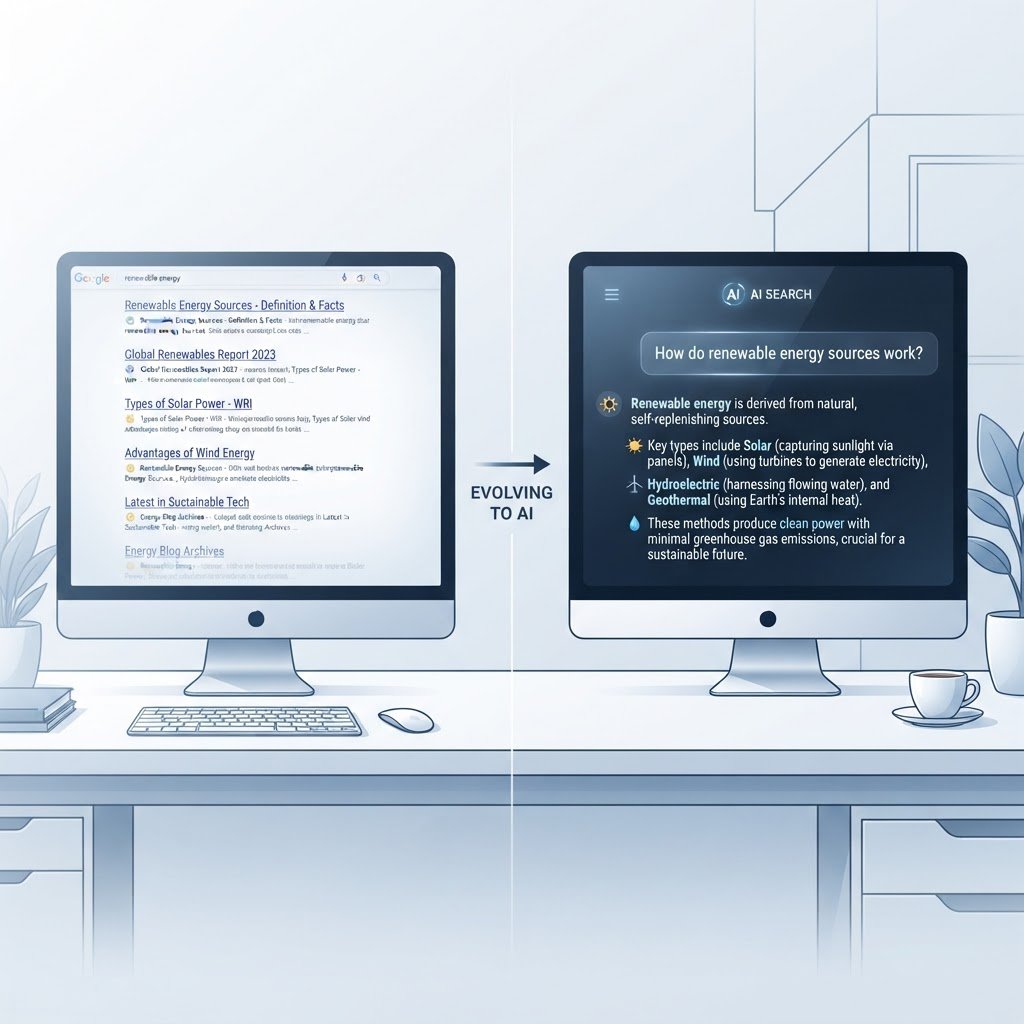
Something has been shifting, quietly, over the past year or so. People are still searching for things, but the way they search and what they expect back has changed. Instead of a list of blue links, they want a sentence. Instead of browsing, they want a conversation. And instead of clicking through five websites to piece together an answer, they want it delivered in one go. This is the quiet rise of AI-powered search, and it is reshaping the internet in ways that are more profound than they first appear.
The change did not happen overnight. It started with chatbots that could hold a conversation, then moved to search tools that could summarise, and now sits somewhere in between, a hybrid where you ask a question and receive an answer that reads like it was written for you specifically. The technology behind it is not magic, though it can feel that way. Large language models, trained on enormous amounts of text, predict what words should come next based on patterns they have learned. When you ask about the best way to remove a coffee stain, the model does not look up a single page and copy the answer. It synthesises information from many sources and produces a response that is often more useful, and certainly faster, than clicking through a dozen results.
What makes this shift interesting is not just the technology. It is the behaviour change that comes with it. People who once opened ten browser tabs to research a topic now ask one question and read one answer. Students who used to scan Wikipedia and three articles for a summary now get one in seconds. Shoppers comparing products no longer scroll through review after review; they ask for the key differences and get a paragraph. The habit of browsing, of wandering through the web’s corridors and stumbling onto things, is being replaced by a more direct, more efficient, and arguably less serendipitous way of finding information.
There are trade-offs here that deserve attention. When search engines surface ten links, the user makes choices. They decide which source to trust, how deep to go, and when they have enough information. That process, slow as it can be, builds a kind of literacy. You learn which sites are reliable, which are filler, and which have the detail you need. When an AI delivers a single answer, that literacy is outsourced. The model does the filtering, the evaluating, and the summarising, and the user gets the result without seeing the work. For quick questions, this is a genuine convenience. For complex ones, it can be a quiet loss.
The concern that comes up most often is accuracy. AI search tools are known, in the industry’s gentle phrasing, to hallucinate. They produce answers that sound confident and correct but are sometimes wrong, sometimes subtly and sometimes spectacularly. A model might cite a study that does not exist, or blend two statistics into one that is misleading, or present an opinion as a fact. For someone searching for a recipe, the stakes are low. For someone searching for medical information or financial advice, the stakes are considerably higher. The major search companies are aware of this and have built in various safeguards, but the tension between speed and accuracy is not going away.
There is also a question about what happens to the websites that have spent years building useful content. If an AI search tool summarises an article and delivers the answer without the user ever visiting the original page, the website loses a visitor. That visitor might have seen an advertisement, signed up for a newsletter, or discovered related content. Multiply that across millions of queries and the economics of publishing start to look fragile. Some publishers have responded by blocking AI crawlers, others by negotiating licensing deals, and others by waiting to see what happens. The outcome is still uncertain, but the direction is clear: the relationship between search and the websites it relies on is being renegotiated.
For the average person, though, these structural concerns are distant. What they notice is that search has gotten better in ways that matter to them day to day. Planning a trip no longer means reading fifteen travel blogs. Comparing two laptops no longer means watching six video reviews. Understanding a new concept no longer means starting with a Wikipedia article and falling into a rabbit hole of related topics. The friction is gone, and most people are not missing it.
What they might be missing, without quite realising it, is the serendipity. The old web was full of happy accidents. You searched for one thing and found another. You followed a link from a forum to a blog to an essay that changed how you thought about something. The new search is efficient, but efficiency and discovery are not the same thing. A well-answered question closes a loop. Browsing, for all its inefficiency, opened doors.
The companies building AI search are aware of this and are experimenting with features that bring some of that discovery back. Some tools now include links to sources alongside their answers, so users can dig deeper if they want. Others offer follow-up questions and related topics, trying to recreate the feeling of wandering. These are early attempts, and it is too soon to say whether they will satisfy the people who miss the old way of searching, or whether the new way will simply become the only way.
There is also a generational dimension to all of this. Younger users, who grew up with smartphones and voice assistants, have always been more comfortable asking a question and getting a spoken or written answer back. For them, the idea of typing keywords into a search box and scrolling through results may already feel antiquated. They are not mourning the loss of browsing because they never did much of it to begin with. The shift to AI search is, for them, not a shift at all. It is just how search works.
For older users, the change can feel more disorienting. The muscle memory of searching is strong, and the habit of evaluating sources is hard-earned. Trusting an AI to do that work requires a leap that not everyone is ready to make. But the convenience is a powerful persuader, and convenience has a way of winning eventually.
The broader question is what this means for the internet as a whole. The web was built on the idea that information should be linked, discoverable, and open. Search engines were the maps that helped people navigate it. If AI search becomes the dominant way people find information, the map and the territory start to blur. The answer you get is not the web itself but a rendering of it, filtered through a model that has its own priorities, biases, and blind spots. Whether that is an improvement depends on what you valued about the old way.
What seems certain is that the change is not reversible. AI search is not a feature that people will opt out of once they have tried it. It is faster, easier, and often better, and those qualities tend to win. The question is not whether the shift will happen but what we will lose in the process and whether we can build something that preserves the best of both worlds. The web’s gift was always its abundance. AI search’s promise is clarity. Finding a way to have both is the challenge that sits quietly behind every query.
For now, the best approach may be the one many people are already practising without naming it: using AI search for the quick answers and old-fashioned browsing for the things that matter. Let the model summarise the news, but read the original article for the nuance. Let it compare the specs, but watch the review for the opinion. Let it give you the headline, but click through for the story. The tools are new, but the wisdom of checking your sources is not, and it may matter more now than it ever has.




