
A perspective piece from The Listening Market
For most of the last century, the resume was the definitive document of professional life. It was the thing you polished before a job interview, the thing you updated after a promotion, the thing you handed to a recruiter or uploaded to a portal with a quiet sense of hope. Two pages, maybe three, a list of roles and responsibilities and the dates you held them. It was a format so universally understood that questioning it felt almost rude.
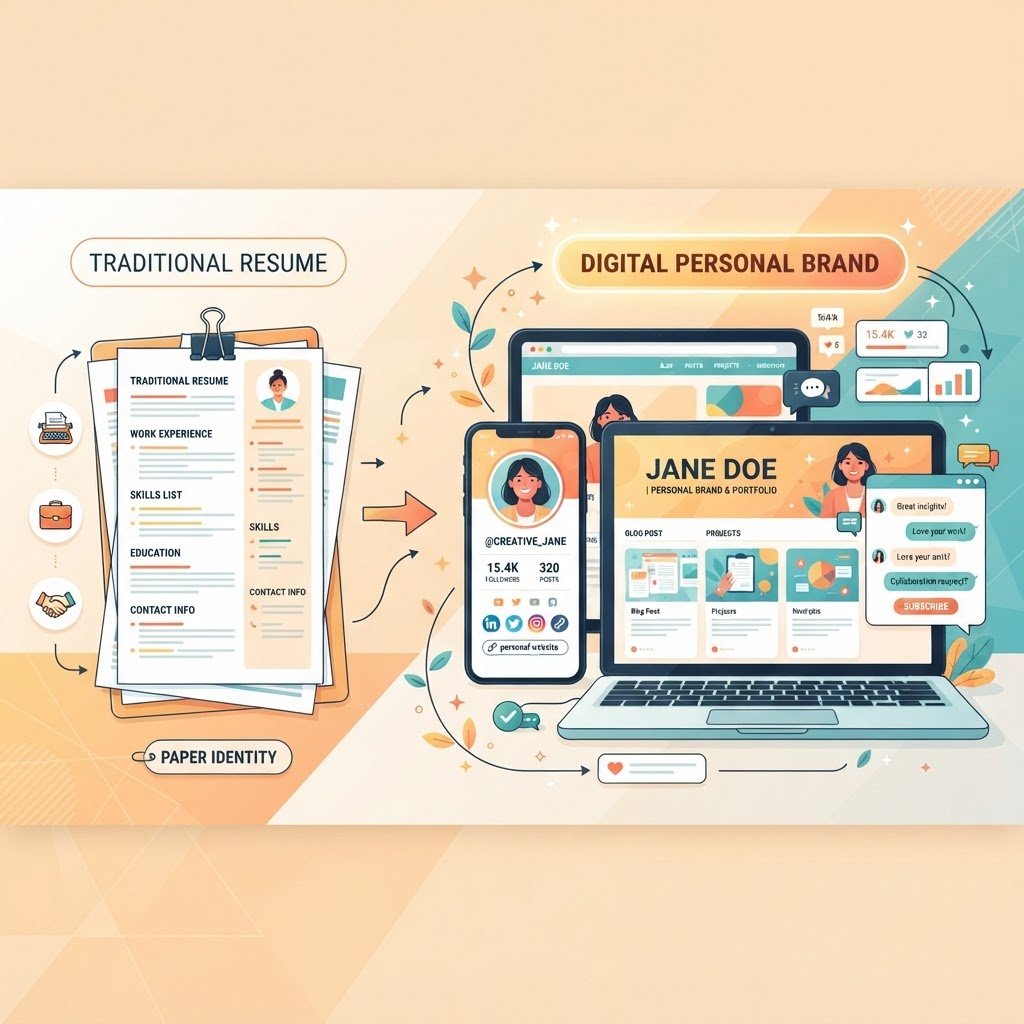
That format is still with us, of course. People still write resumes and companies still ask for them. But something has been shifting in the way people think about professional identity, and it has less to do with formatting and more to do with what a resume actually represents. A resume tells someone what you did. A personal brand tells someone who you are, what you think, and why it matters. In a world where attention is scarce and trust is fragile, the second one is starting to win.
The shift began, as so many shifts do, with the internet. Social media gave everyone a broadcasting platform. First it was blogs, then it was Twitter, then LinkedIn evolved from a digital rolodex into something closer to a publishing channel. At some point along the way, people started to realise that the content they shared and the conversations they joined were doing more for their careers than any resume ever had. A well-written post about a problem you solved at work could reach thousands of people. A thoughtful thread about a trend in your industry could get you invited to speak at a conference. A consistent voice, over time, could make you the person people thought of when a particular topic came up.
None of this is new in principle. Reputation has always mattered. What changed is the scale and the speed. Reputation used to travel slowly, through word of mouth and professional networks. Now it travels at the speed of a share button. Someone on the other side of the world can encounter your thinking, form an opinion about your expertise, and decide to work with you, all without ever seeing your resume. The resume has become a formality, a checkbox at the end of a process that the brand has already won.
This is not just a story about social media, though. It is about a deeper change in how people think about work and value. The resume was designed for a world of stable employment, where careers followed predictable paths and roles had clear descriptions. You worked at a company for years, accumulated responsibilities, and listed them in reverse chronological order. The document assumed that what you did at Company A was relevant to what you might do at Company B, and that the title on your business card said something meaningful about your capabilities.
That assumption has been weakening for years. People change jobs more often, switch industries more freely, and combine skills in ways that do not fit neatly into a bullet point. A marketing manager who taught herself data analytics and now runs growth experiments is not well served by a format that asks her to list her previous job titles. Her resume says one thing. Her personal brand, built through posts and talks and projects, says something far more accurate and compelling.
The rise of the creator economy has accelerated this shift. People who build audiences around their expertise are finding that the audience itself is the asset. A newsletter with ten thousand subscribers is more persuasive than a resume with ten years of experience, because the subscribers are proof that people value what you have to say. A portfolio of public work, whether it is writing, videos, code, or designs, is evidence that a resume can only claim. The gap between showing and telling has never mattered more.
There is something democratic about this shift. A resume favours people who went to the right schools and worked at the right companies. A personal brand can be built by anyone with a point of view and the discipline to share it consistently. Talent that was previously invisible, locked inside organisations that did not recognise it, now has a path to the surface. People who might have been overlooked by traditional hiring processes are finding opportunities because someone stumbled across their work and reached out.
But there is a tension here that is worth acknowledging. Not everyone wants to be a brand. Not everyone is comfortable sharing their thoughts publicly, or has the time to build an audience alongside doing their actual job. The expectation that professionals should also be content creators can feel like another burden, another thing to keep up with in a world that already asks too much. There is a difference between choosing to share your work and feeling required to perform it.
There is also the question of what happens when personal branding becomes performative rather than authentic. The line between sharing genuine insight and curating a highlight reel is thin, and the incentives of social media push people toward the latter. A feed full of confident takes and polished stories can obscure the messiness of real work, the failures, the doubts, the things that did not go as planned. When everyone is a brand, the brands start to look the same, and the value of standing out starts to diminish.
Still, the trend is real and it is not reversing. Companies are paying attention. Some have started hiring based on portfolios and public work rather than resumes. Some are building their own brands around the personal brands of their employees, encouraging them to post and share and become visible. The logic is straightforward: in a noisy market, trust is the differentiator, and trust is built by people, not by logos. A company whose employees are known and respected in their fields has an advantage that a company with a polished careers page but no public faces cannot match.
For individuals, the practical implications are significant. Building a personal brand does not require going viral or accumulating a massive following. It requires consistency and a willingness to be specific. The most effective personal brands are not the broadest ones but the most focused. Someone who writes regularly about a narrow topic, who becomes known for a particular kind of expertise, is more memorable than someone who posts about everything. Depth beats breadth, and regularity beats brilliance. A post every week for a year will do more than a single post that goes viral and is then forgotten.
The other thing that a personal brand does, which a resume cannot, is age well. A resume is a snapshot, frozen in time, accurate only at the moment it was written. A personal brand is a living thing, evolving as you learn and grow. It shows progression in a way that a list of job titles cannot. It lets people see how your thinking has changed, what you have learned, and what you care about now. That depth is something a two-page document was never designed to capture.
None of this means the resume will disappear entirely. Formal processes still require formal documents, and some industries and roles will always ask for them. But the resume’s role is shrinking from the primary representation of a person’s professional identity to a secondary one, a formality that confirms what the brand has already established. The work of building a career is increasingly the work of building a reputation in public, and the people who understand this are finding that the opportunities come to them rather than the other way around.
The shift from resume to personal brand is, at its core, a shift from credentials to evidence. A credential says you were somewhere. Evidence shows what you did there and what you think about it now. In a world where information is abundant and attention is scarce, evidence wins. It is more specific, more trustworthy, and more memorable. The resume told people what you were. The brand shows them what you are becoming, and that, it turns out, is what people actually want to know.




