
A perspective piece from The Listening Market
There was a time when the loudest thing a person could say about themselves was how little they slept. Four hours a night, a laptop glowing at 2 a.m., a coffee cup as a personality trait. Exhaustion used to be a badge of honour, proof that a life was full, important, relentlessly in motion. That time is ending. In 2026, the most quietly confident thing a person can signal is not how much they work, but how well they rest. Sleep has become the new status symbol.
The bragging rights have flipped
The shift has been gradual, then suddenly unmistakable. Ask a busy professional how they are doing and the answer is no longer a proud recitation of burnout. It is more likely to be something almost smug: “I was in bed by nine-thirty.” Sleep scores are shared the way marathon times once were. Whoop and Oura ring groups trade recovery numbers. A full eight hours has become the new corner office.
The inversion says something deeper about how status itself has changed. Conspicuous busyness once signalled importance, because being in demand meant being needed everywhere at once. But busyness is cheap now. Everyone is busy. Calendars overflow by default, inboxes refill by themselves. When a behaviour is universal, it stops differentiating anyone. What has become rare, and therefore valuable, is the discipline to switch off.
Rare things become status markers. In a culture that runs on stimulation, a rested nervous system is the ultimate luxury good. It says: my life is under control. My work does not require me to sacrifice myself. I have boundaries, and I have the power to enforce them. Nobody announces that from a treadmill at midnight.
What science did to the hustle culture myth
The cultural flip did not happen by accident. It followed an avalanche of research that reframed sleep from lost time to active maintenance. Sleep is when the brain clears metabolic waste, when memories consolidate, when the glymphatic system quietly does its washing. Athletes were among the first to take it seriously, treating sleep as a performance tool rather than an obstacle to it. Sleep directors appeared at elite football clubs. Basketball players credited a nine-hour minimum with changing their careers.
Then the science leaked into everyday conversation. Sleep researchers became podcast regulars. Books about rest topped bestseller lists for years. The repeated message was simple and damning: chronic short sleep is linked to worse memory, weaker immunity, impaired emotional regulation and long-term cardiovascular risk. The people who were proudest of surviving on five hours were, in the emerging picture, not warriors but canaries.
That reframing changed the moral character of sleeplessness. Staying up late used to look like ambition. Now it increasingly looks like bad planning, or something worse: an inability to protect one’s own life from the demands of others. In that light, the well-rested person seems competent and sovereign, while the perpetually exhausted one seems, fairly or not, overwhelmed.
How the luxury market caught on
Status signals always attract commerce, and sleep has been thoroughly commodified. The sleep economy is now worth hundreds of billions of dollars globally, and it is no longer limited to mattresses. There are cooling coverlets, smart rings, sunrise alarms, mouth tape, magnesium sprays, weighted blankets and sleep-tracking watches that grade every night like a school exam. Hotel brands advertise sleep menus the way they once advertised pillow chocolates. Wellness retreats now sell rest with the same intensity that yoga retreats once sold flexibility.
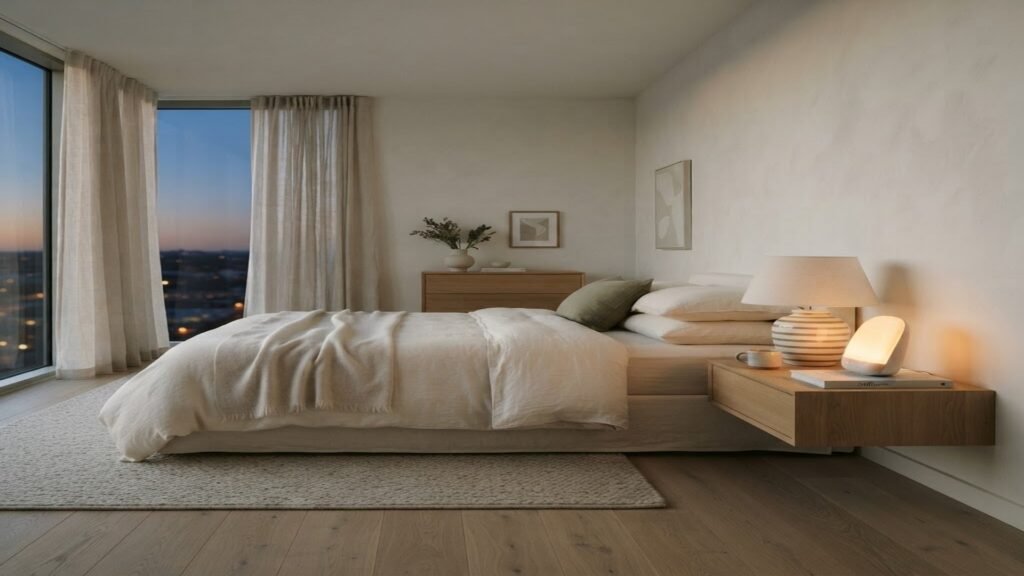
The aesthetics matter as much as the gadgets. Sleep has developed a visual language: linen sheets in oatmeal tones, dim amber lamps, bedrooms styled like monasteries, the bedside table holding nothing but a book and a glass of water. Scroll through almost any lifestyle feed and the message is consistent. The person who sleeps beautifully lives beautifully. Rest is being marketed as a form of taste.
This is how status works. Once a behaviour requires resources of some kind: money, discipline, or the autonomy to control one’s own evenings, it can be leveraged into identity. And sleep requires the most scarce resource of all, which is freedom from obligation.
The freedom hiding inside a bedtime
That is the quiet engine of sleep’s new prestige. Most people cannot simply choose to sleep well. A nurse on rotating shifts, a parent of a newborn, a worker holding down two jobs, they would love nine hours, but their lives do not permit it. When a freelancer mentions, casually, that they never take meetings before ten because of their sleep routine, they are not describing a health habit. They are describing power: a life elastic enough to organise itself around rest.
Compare that with the old status symbol of availability. The person who answered emails at midnight signalled that others depended on them. The person who is unreachable after nine signals that they decide when the day ends. It is the difference between being needed and being in charge, and the culture has clearly decided which one it envies now.
Employers have noticed the change too. Burnout has become expensive, and its costs are visible in attrition, errors and lost creativity. Companies began advertising uptime targets and rest days the way they once advertised ping-pong tables. Sleep has entered the benefits conversation alongside health insurance. What began as an individual fad is becoming an institutional expectation.
Sleep-washing deserves a skeptical eye
None of this should be swallowed whole. Whenever a virtue becomes fashionable, an industry arrives to sell a shortcut, and the sleep industry has produced its share of expensive placebos. A four-hundred-dollar pillow cannot fix a life built on overcommitment. A tracking ring can easily turn rest into another realm of anxiety, where one bad night becomes a data point to dread and a good score becomes another metric to chase. There is a special irony in lying awake because the device on the nightstand will soon deliver a verdict.
The genuine article is less photogenic and more powerful. Consistency is the unsung hero, an anchor wake time that barely changes, a wind-down that is boring in the best way, a bedroom that is cool, dark and free of arguments. Sleep hygiene is not particularly marketable because most of it is free. Darkness, regularity, and a life with fewer things scheduled after dinner cost nothing, which is exactly why they are available to almost everyone and pursued by so few.
It is also worth resisting the trap of turning rest into one more performance. The point of sleep becoming valuable is that it pushed back against a culture that treated exhaustion as proof of worth. If sleep simply becomes the new arena for optimization anxiety, the hustle has won by other means. Rest that is scheduled, scored, optimized and performed is not entirely rest at all.
What the well-rested actually do differently
Setting the marketing aside, the habits that separate genuinely good sleepers from aspirational ones turn out to be almost embarrassingly unglamorous. They treat their bedtime as an appointment with consequences rather than a suggestion. They give the last hour of the evening to low-stimulation activities, because the nervous system does not switch off on command after a day of urgency. They keep phones charging outside the bedroom, a boundary that sounds trivial until it is tried and turns out to be the single most effective sleep intervention available without a prescription.
They are also careful with light, which is the master clock of the body. Morning daylight anchors the circadian rhythm; dim evenings let it descend gently. They watch caffeine, not necessarily by giving it up, but by letting it fade before mid-afternoon. None of it photographs well. There is no product to hold, no score to post. There is just a person who has quietly decided that the day has a shape, and that the shape ends.
The deeper story behind the trend
Sleep’s rise to prestige is really a story about a society recalibrating what a good life looks like. The generations now shaping mainstream culture watched the always-on work ethic consume their parents and decided the trade was a poor one. They watched burnout become a mass experience rather than an individual failing. The wellness movement they built, with its yoga, its digital detoxes, its slow mornings, is best understood as a collective attempt to reclaim time.
Sleep is the most absolute of those reclamations. Meditation can be squeezed into ten minutes. Holidays end. But sleep happens every night, and it cannot be faked or banked. To protect it is to make a daily commitment that the day will end, that the body’s needs outrank the feed’s demands. A person who defends that commitment day after day is displaying a rare kind of agency.
So when someone mentions, unhurried and mildly pleased, that they got a full night’s sleep, hear it for what it is. It is not merely a health update. It is a small announcement that their life is ordered, their work is survivable and their evenings belong to them. It is the whisper of a person who has chosen to be well.
The badge of exhaustion is fading. In its place is something quieter and harder to earn: the rested face. Not the tanned face, not the wealthy face, but the one that has slept deeply, night after night, in a life slow enough to allow it. That is the new flex. It requires no audience, performs nothing, and broadcasts its own kind of wealth.




