
A perspective piece from The Listening Market
Picture a morning in 2035. The alarm doesn’t ring; the room brightens gradually, calibrated to the season and the quality of light outside. The shower has already warmed to the preferred temperature, drawing from water recycled through the home’s own filtration loop. The kitchen knows the coffee is meant to be strong today because sleep data from the wearable on the nightstand told it so. Nothing beeps. Nothing flashes. The house simply anticipates, quietly, the way a good host might.
This is not the smart home of a decade ago — the one that required an app for every lightbulb and a vocabulary of voice commands that felt more like talking to a vending machine than living in a house. The home in 2035 is something else entirely. It thinks differently. And the difference between “smart” and “thinking” may be the most important architectural shift of our time.
The Market Is Moving Faster Than the Conversation
Before imagining the texture of daily life, it helps to understand the scale of the shift. The global smart home market is projected to grow from roughly USD 216.3 billion in 2025 to USD 489.2 billion by 2035, according to Future Market Insights. That is an 8.5% compound annual growth rate sustained over a decade. More telling is the acceleration of AI specifically within those homes: the autonomous AI in smart homes market, valued at around USD 18.1 billion today, is estimated to reach USD 171.29 billion by 2035, per Precedence Research. The money is flowing toward systems that do not wait for instructions.
Underpinning this is a quieter revolution in interoperability. The Matter protocol — a unifying connectivity standard backed by the major technology companies — had a device market valued at USD 14.8 billion in 2025 and is projected to reach USD 52.6 billion by 2034, according to MarketIntelo. In plain terms, this means the era of devices that refuse to speak to one another is ending. The home in 2035 is built on a common language, and that language is finally being written.
The House That Listens Before It Acts
The defining trait of the home in 2035 is not the number of sensors or the speed of its processors. It is the quality of its attention. Where current smart homes respond to commands — a voice, a tap, a schedule — the next generation of homes will observe and interpret. Ambient sensing, already emerging through Wi-Fi mesh detection and毫米wave radar, will allow a house to understand occupancy, movement patterns, and even physiological signals without cameras or microphones in every room.
This is what the industry calls the shift from IoT to AIoT — the Artificial Intelligence of Things. As described by the sensing technology firm nami, future smart homes will move beyond manual instruction toward systems that learn occupant preferences and routines over time, adjusting lighting, heating, and security autonomously. The goal is not more control. It is less. The home in 2035 aims to reduce the number of decisions a person makes in a day, not add to them.
Consider the implications for something as simple as coming home from work in a storm. A contextually aware building — as the American Apartment Owners Association describes in its 2035 outlook — might raise the temperature slightly and warm the lighting to offset the grey outside, while floor sensors detect wet footprints and redirect cleaning systems before anyone slips. None of this announces itself. It simply happens, and the resident feels cared for without quite knowing why.
Energy Becomes Instinct, Not Effort
Buildings currently account for about 30% of global final energy consumption, according to the International Energy Agency. That figure has stubbornly resisted improvement, in part because most of the housing stock that exists today will still exist in 2050. Research published through the National Institutes of Health notes that roughly 75% of buildings in Europe are energy inefficient, and between 85% and 95% of them will still be standing by mid-century. The home in 2035, then, is not only a new building. It is also a retrofitted one, layered with intelligence over existing bones.
The IEA has called for at least a 60% reduction in building-sector emissions by 2030 compared to 2015 levels — a target that demands homes stop being passive consumers and become active participants in energy systems. The 2035 home is designed to do exactly that. Solar surfaces replace conventional roofing. Battery storage is standard, not optional. Smart meters talk to the grid in real time, allowing a household to sell surplus energy back during peak demand and draw during troughs. The circular model — where energy is consumed only as needed, and waste is repurposed rather than discarded — replaces the linear habit of leaving appliances on standby indefinitely.
In some cases, homes will become net energy generators. The architecture will not merely sustain itself but contribute to the neighbourhood around it. This reframes the house from a private shelter into a node in a wider civic metabolism.
Materials That Age Well and Heal
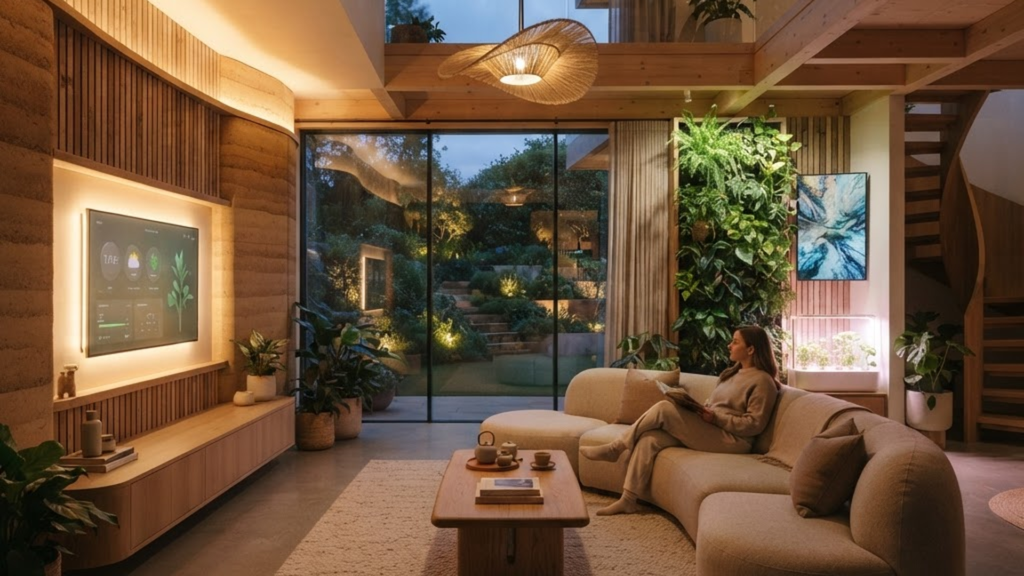
The aesthetics of the 2035 home will look less like a gadget and more like a garden. The design world’s pivot toward biophilic design — integrating nature into the built environment — has moved from a niche preference to a mainstream principle. Living walls, indoor air-purifying plant systems, and timber construction are not decorative choices but functional ones. Cross-laminated timber, for instance, sequesters carbon while offering structural strength comparable to steel and concrete at a fraction of the embodied emissions.
Recycled and repurposed materials will dominate new construction. The emphasis, according to architectural trend forecasts from firms like WGSN tracking interiors through 2035, is on warmth and honesty in materials — surfaces that tell the story of where they came from. A countertop made from compressed recycled glass. Flooring milled from reclaimed timber. Insulation grown from mycelium. The home in 2035 does not pretend to be pristine. It is honest about its history and its footprint.
This is also a response to a growing cultural fatigue with the sterile, screen-heavy minimalism that defined the 2010s and 2020s. The pendulum is swinging toward texture, imperfection, and the tactile. People want homes that feel alive, and designers are responding by building environments that literally are.
The Interface That Disappears
Perhaps the most profound change is the one you will not see. The home in 2035 has fewer screens, not more. The interfaces retreat into the walls, the surfaces, the fabric of daily life. Projection systems turn any wall into a display only when needed. Voice assistants give way to ambient computing that infers intent from context rather than waiting to be summoned. The refrigerator no longer has a tablet bolted to its door; it simply manages its own contents and adds to a shopping list that lives on the phone already in a pocket.
This is what the Wall Street Journal’s room-by-room analysis of the future house describes as the disappearance of appliances — technology that is present and functional but no longer demands to be looked at. The bathroom becomes a passive health monitor, analysing signals in water and waste to flag early indicators of illness. The bedroom tracks sleep architecture without a wearable, using ambient sensors to adjust temperature and air quality through the night. The living room adapts its acoustics and lighting to the activity, whether that is a conversation, a film, or a child’s homework.
The philosophy behind all of this is simple: the best technology is the kind you forget is there. The home in 2035 does not perform its intelligence. It embodies it.
Health as a Foundation, Not a Feature
Wellness has been a buzzword in real estate for years, but by 2035 it will be structural. The connection between indoor air quality, circadian lighting, and long-term health is now well established, and building standards are catching up. Homes will be designed from the studs outward to support the people inside them — filtering air to reduce asthma triggers, managing humidity to inhibit mould, and tuning light spectra to support natural circadian rhythms.
The emotional dimension of this is just as significant. The AAOA’s 2035 forecast describes what it calls emotional architecture — spaces designed to respond to and support mood. Hospitals tuning light to calm patients’ heart rates. Schools adjusting acoustics when noise becomes overwhelming. The same principle applies in the home: a space that recognises when its occupants are stressed, tired, or unwell, and adjusts itself accordingly. Not through surveillance, but through a kind of environmental empathy built into the walls.
This raises legitimate questions about privacy. A home that understands its occupants is also a home that holds intimate data. The home in 2035 will need to be not only intelligent but trustworthy — with local processing, encrypted sensing, and transparent data policies that give residents genuine ownership over what their house knows about them. The technology is arriving. The governance must keep pace.
The Question of Who Gets to Live There
There is a risk in all of this optimism, and it needs to be named. If the home in 2035 is healthier, more efficient, and more responsive, it may also be more expensive. The gap between a house that thinks and one that merely shelters could widen existing inequalities in housing quality and health outcomes. Policy, subsidy, and open standards will determine whether these advances become the average or remain the privilege.
The Matter protocol’s open approach is a hopeful sign — a shared language that prevents lock-in and encourages competition. But technology alone does not ensure access. The homes that most need retrofitting — older, less efficient, often occupied by those with the fewest resources — are the hardest to upgrade and the least profitable to serve. The story of the home in 2035 is not only about what is possible. It is about what is shared.
A House That Holds You Differently
The home in 2035 will not look like a science fiction set. It will look, in many ways, like a good home today — with light, warmth, texture, and the quiet rhythm of daily life. The difference will be underneath. In the systems that breathe with the seasons. In the surfaces that generate power. In the air that is cleaner inside than out. In the way a space can sense when someone is struggling and respond with a gentler light, a warmer room, a calmer soundscape.
The most honest way to describe it is this: the home in 2035 will not be defined by what it does for you. It will be defined by how it holds you. And if the architecture, the technology, and the policy align, it may hold people better than any generation of housing has before. That is not a prediction about gadgets. It is a statement about what we choose to build — and who we build it for.