A perspective piece from The Listening Market
There was a time, not so very long ago, when admitting you slept well felt vaguely embarrassing. To say you’d had eight unbroken hours was to confess, in certain rooms, that you lacked ambition. The people worth admiring were the ones who ran on four hours and black coffee, who answered emails at 2 a.m., who treated exhaustion as a credential. Sleep was the thing you sacrificed on the altar of being taken seriously.
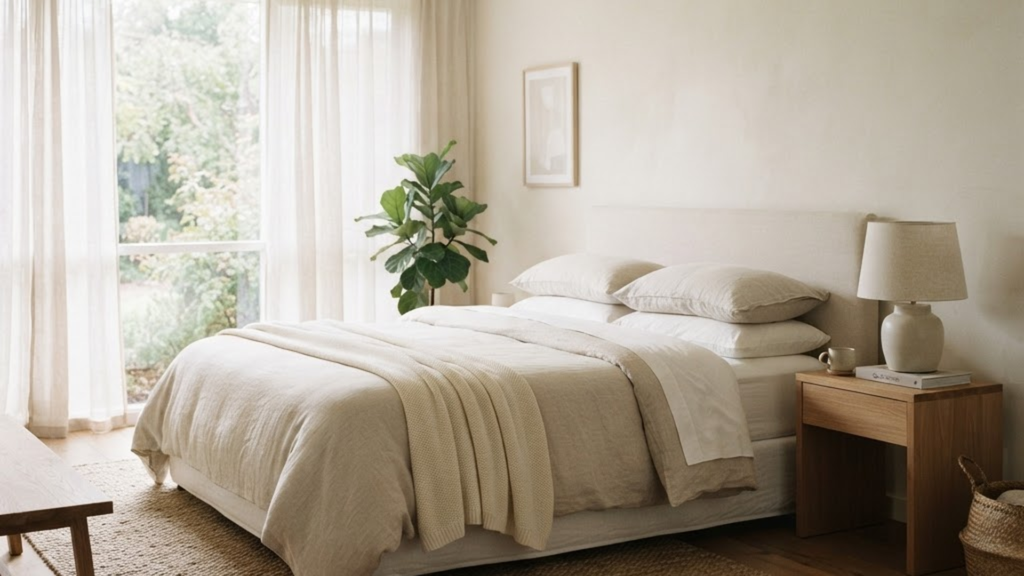
Something has shifted. Quietly at first, and now in a way that feels impossible to ignore, rest has moved from the margins of indulgence to the very centre of what it means to be doing well. A good night’s sleep has become the sleep status symbol of 2026 — a marker of discipline, of resources, of a life arranged around something other than perpetual motion. The flex has flipped. Nobody is impressed by the person who says they’re running on empty anymore. The person worth envying is the one who woke up, slow and unhurried, after nine hours of deep, measured, optimised rest.
The old badge of honour
To understand the reversal, it helps to remember what came before. For the better part of two decades, exhaustion was currency. The startup founder who slept under the desk was a folk hero. The phrase “sleep is for the weak” was worn like a motto, printed on mugs and repeated without irony. A 2024 study by researcher Elijah Wee at the University of Washington’s Foster School of Business explored precisely this phenomenon — why people brag about going without rest — and found that sleep deprivation was used as a signal of dedication and industriousness, a way of demonstrating that work mattered more than the body’s demands.
It was a peculiar kind of performance. You were not simply tired; you were tired in a way that proved you mattered. The busier you were, the more sleep you could forgo, the more important you must be. The logic was self-reinforcing and, as it turned out, self-destructive.
Because here is the thing the hustle orthodoxy preferred to overlook: the body keeps the receipts. According to research published by the RAND Corporation, insufficient sleep costs the United States economy up to $411 billion every year, equivalent to roughly 2.28 percent of GDP. A separate study cited by Harvard Medical School, published in the journal SLEEP, estimated that insomnia alone costs the American workforce $63.2 billion annually in lost productivity — an average of 11.3 days, or $2,280, per affected worker. The Centers for Disease Control and Prevention has reported that more than one in three American adults — around 35 percent — regularly get less than the recommended seven hours of sleep. We were, in other words, a society wearing its own depletion as a badge of honour while quietly going bankrupt in the currency of health.
When rest became aspirational
The turn did not happen overnight, and it did not happen for a single reason. It happened at the meeting point of several slow-moving currents: a wellness culture that had exhausted every other frontier, a generation of consumers who had watched their parents burn out, and a class of technology that made the invisible suddenly visible.
Because for most of human history, sleep was opaque. You either woke up feeling decent or you didn’t, and beyond that there was not much to say. You could not measure it. You could not optimise it. You could not, crucially, display it. Then came the wearables. The Oura Ring, the Whoop band, the Apple Watch, the Eight Sleep’s temperature-regulating mattress cover, the Bía sleep device — a whole ecosystem of sensors that turned the unconscious hours into a dashboard. Suddenly rest had a score. Suddenly there were graphs. Suddenly you could post a screenshot of your night the way you once posted a photo of a holiday, and the right people would understand exactly what it meant.
What it meant was this: that you had the time, the money, and the control. You had the time to sleep eight hours because your life permitted it. You had the money for a ring that cost as much as a small appliance, for bedding engineered like a sports car, for blackout curtains and magnesium supplements and a mattress that regulated its own temperature. And you had the control — over your schedule, your environment, your nervous system — to actually use these things. Sleep, once the thing you had no choice but to sacrifice, had become something you could curate.
The economics of the unconconscious
The market heard the shift before most people did. According to data from Market.us, the global sleep economy — the sprawling category that covers everything from mattresses to supplements to apps to white-noise machines — reached $585 billion in 2024. Research and Markets valued the core sleep market at around $66 billion in 2025, growing at roughly 6.7 percent annually. The sleep tech device segment alone was estimated at $29.3 billion in 2025 and was projected to climb to $34.7 billion in 2026, according to industry analysis reported by Yahoo Finance. In October 2025, Oura — the Finnish maker of the sleep-tracking ring that has become shorthand for a certain kind of optimised life — was valued at around $11 billion.
These numbers tell a story, but they also raise a question that is worth sitting with. When something becomes a market of that size, it tends to split along the usual lines. There is the version of sleep optimisation that costs thousands, and there is the version that costs nothing. There is the sleep status symbol of the person with the climate-controlled bed and the sleep coach and the wind-down ritual timed to their circadian rhythm, and there is the sleep of the person working two jobs who is simply trying to get enough of it to stay functional. The same restless economy that elevated sleep to luxury is, in many cases, the one that makes it hardest to come by for the people who can least afford to lose it.
This is the contradiction at the heart of the trend, and it is the one most easily lost when the conversation turns to rings and mattresses and morning light. Sleep became a status symbol in part because it became scarce, and it became scarce in part because the conditions of modern life — irregular hours, screens, economic precarity, the always-on expectations of work — conspired to make it so. The same Gallup research that found poor sleep linked to billions in lost productivity also found that the workers most affected are often those with the least control over their schedules. To treat sleep as a personal achievement, then, is to risk mistaking a structural problem for an individual virtue.
What the data actually says about a good night
Strip away the gadgetry and the discourse, and the underlying case for sleep is not complicated. The body needs it. The brain needs it. Decades of research, summarised again and again by the CDC and the National Sleep Foundation, converge on the same baseline: most adults function best on seven to nine hours. Chronic shortfall is linked to higher rates of cardiovascular disease, metabolic disruption, impaired cognition, weakened immunity, and poorer mental health. A study reported in the Harvard Business Review found that sleep deprivation can reduce productivity by up to 30 percent. None of this is new. What is new is that we have started, finally, to believe it.
And belief, it turns out, is the part that matters. For years the evidence was there and the culture shrugged. The data said sleep was essential, and the culture said sleep was negotiable. The gap between knowing and doing was not a knowledge problem; it was a values problem. We did not lack information about rest. We lacked a reason to value it.
What the sleep status symbol represents, at its best, is the closing of that gap. The culture has begun to catch up to the science. The ring on the finger is not really about the ring. It is about a society deciding, belatedly, that the thing it could measure all along was worth measuring — and worth protecting — after all.
The quieter revolution
Still, there is a version of this story that is worth resisting. It is the version in which sleep becomes just another arena for performance, just another metric to game, just another way to feel that you are falling short because your deep-sleep percentage is two points below your colleague’s. There is a thin line between valuing rest and commodifying it, and the wellness industry has never been especially careful about which side of that line it stands on.
The more honest reading of the trend is neither the cynical one — that sleep is now just luxury wearing a wellness costume — nor the breathless one, that we have all finally seen the light. It is somewhere in between. Something real has changed. People are, in greater numbers, taking rest seriously as a measure of a life well lived rather than a life lazily lived. That is, on balance, a good thing. The risk is that the good thing curdles into another hierarchy, where the people who sleep best are the people who could afford to, and the people who don’t are blamed for a scarcity they did not choose.
The sleep status symbol, then, is a double signal. It says something hopeful: that a culture which once wore its exhaustion as proof of worth has started to treat rest as something worth protecting. And it says something uneasy: that even sleep, the most universal of human needs, can be turned into a marker of who is thriving and who is not. The best outcome would be for the first reading to win — for the trend to do what the best trends do, which is to pull a neglected truth into the light and make it ordinary. Sleep should not be a luxury. It should not be a badge. It should simply be the thing, unremarkable and essential, that we stop sacrificing.
Until then, the ring will keep its glow, the graphs will keep their promise, and somewhere a person will wake up, check their score, and feel, for a moment, that they have done something impressive simply by closing their eyes and letting the night do its work. There are worse things to aspire to. There are few more telling ones.