
A perspective piece from The Listening Market
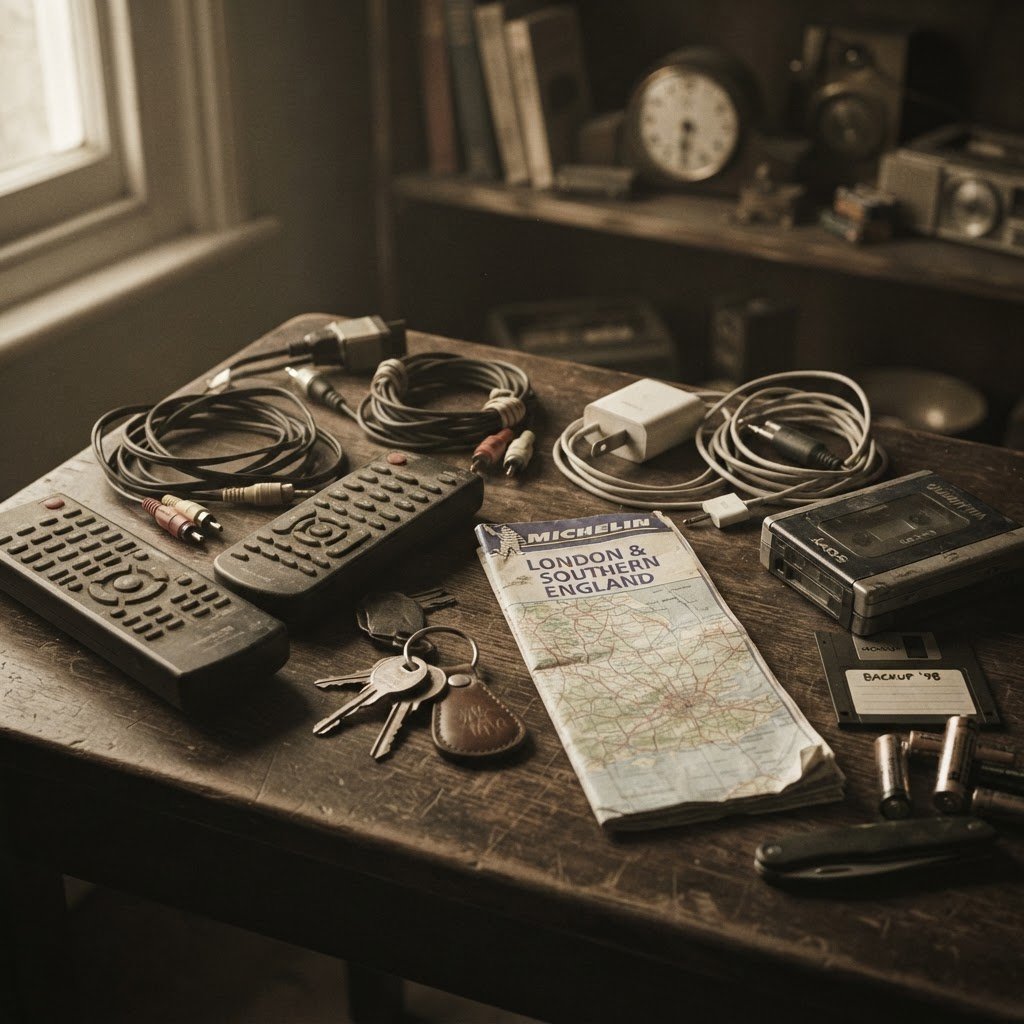
There’s a drawer in nearly every home that serves as a technology graveyard. Cables with unknown purposes. Chargers for phones that haven’t existed in a decade. Remote controls for devices that were recycled years ago. The drawer exists because nobody can bring themselves to throw away something that might be useful, and nobody can remember what any of it was for.
That drawer is a preview. The technologies we use today are building their own drawers — and by 2040, many of them will exist only as artefacts in boxes nobody opens. Not because they failed, but because something better, quieter, and less visible came along and made them unnecessary.
The Physical Key
The metal key is already on borrowed time. Hotels replaced them with cards years ago. Office buildings followed with fobs and biometric scanners. Smart locks have made their way into residential homes, and once a generation grows up without ever carrying a house key, the concept will seem as quaint as winding a watch.
What’s replacing the key isn’t just a digital equivalent — it’s the disappearance of the concept entirely. Phones unlock doors. Faces unlock doors. Voices unlock doors. The act of carrying a small piece of metal that grants access to a space will seem like a ritual from another era, the way sealing wax seems to us now.
The Password
Passwords have been dying for years, and by 2040 they’ll likely be a memory. The replacement isn’t a better password — it’s the elimination of the idea that humans should memorise strings of characters to prove who they are. Biometric authentication, passkeys, and device-based verification are already replacing passwords across major platforms.
According to the FIDO Alliance, passkey adoption has accelerated dramatically, with major tech companies moving toward passwordless authentication as the default. The generation born after 2020 may never create a password in their lives.
The Remote Control
The television remote control is a design compromise that persisted for decades. A rectangle of plastic covered in buttons, most of which nobody uses, dedicated to a single device. It’s the kind of object that makes perfect sense until you realise how absurd it is — a separate physical controller for every appliance, cluttering coffee tables and getting lost between cushions.
Voice control and phone-based interfaces are already replacing remotes in many homes. By 2040, the remote will likely be a relic. Televisions will respond to voice, gesture, and app control. The buttons will exist on a screen, summoned when needed and invisible when not. Coffee tables will have one less thing on them, and nobody will miss it.
The Cable
Charging cables are the modern equivalent of the power cord — ubiquitous, fragile, and perpetually tangled. They break at the connector. They get lost. They come in incompatible formats that change every few years. The cable drawer exists because cables accumulate faster than they’re discarded.
Wireless charging is improving rapidly, and the trajectory suggests that by 2040, most devices will charge through proximity or surface contact without a physical cable. The Wireless Power Consortium continues to expand standards for spatial charging, where devices charge within a certain range of a power source — no cable, no pad, just proximity.
The Paper Receipt
The paper receipt is already disappearing in many retailers, replaced by digital receipts sent by email or app. By 2040, the paper receipt will be a curiosity — a thin strip of thermal paper that fades in sunlight and accumulates in wallets for no reason. The environmental cost alone makes its extinction inevitable, but the practical argument is stronger: nobody keeps receipts, and the ones who need to can’t find them when they do.
The USB Stick
The USB flash drive had a good run. It replaced the floppy disk, the CD-R, and briefly, the external hard drive. But cloud storage, fast wireless transfer, and ubiquitous connectivity have made the USB stick unnecessary for most people. The ones still in use are primarily for security-conscious file transfers or as emergency boot drives — niche uses that will themselves be replaced by better solutions.
The Parking Meter
The coin-operated parking meter has been vanishing from cities for years, replaced by app-based payment systems. What’s left is a pole on a sidewalk with a faded sign telling people to use an app instead. By 2040, even the poles will be gone. Parking will be managed entirely through vehicle-to-infrastructure communication — cars will identify spaces, reserve them, and handle payment automatically.
What Remains
What’s striking about these disappearing technologies is how unremarkable their absence will feel. Nobody mourns the floppy disk. Nobody misses dial-up internet. The technologies that vanish are the ones that were never loved — they were tolerated, used because they existed, and abandoned the moment something better appeared.
By 2040, the drawer of obsolete cables and forgotten remotes will be smaller. The surfaces of homes will be less cluttered. The friction of daily life will continue its slow reduction. And the technologies that replace the ones we’re losing will be less visible, more integrated, and — in their own quiet way — more human.
The future of technology isn’t more objects. It’s fewer. And that might be the most optimistic prediction anyone can make about the next fifteen years.