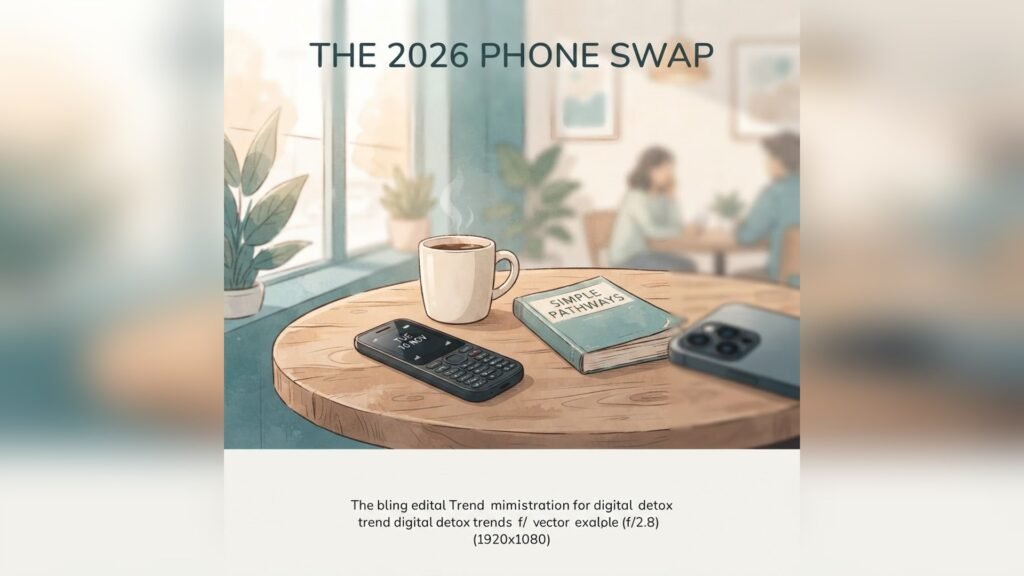
A perspective piece from The Listening Market
There is a particular expression people wear when they describe switching from a smartphone to a basic phone, and it is not deprivation. It is relief. A project manager in Sydney keeps a call-and-text handset in his pocket during weekends and describes the change the way former commuters describe leaving the city: as though a pressure he had stopped noticing has dissipated. A university student carries a phone with buttons on it and gets asked about it at parties, where the questions are never mocking — they are envious. Over there, a mother of two has moved the family WhatsApp to a tablet at home and carries a phone that cannot do anything more interesting than ring. Nobody in these stories has given up technology. They have given up carrying it in their hand for sixteen hours a day.
A few years ago, this was a fringe gesture — the digital equivalent of keeping a beehive. In 2026 it has become a recognisable consumer movement, complete with waiting lists for certain retro handsets, and it says something uncomfortable about how the last fifteen years of mobile technology actually went.
The phone that became a corridor
To understand why anyone would downgrade voluntarily, it helps to look at what the smartphone quietly became. The founders of the modern smartphone may or may not have foreseen it, but the product evolved into a corridor with a door for everything: work, news, commerce, romance, argument, entertainment, banking, memory. Every corridor drew rent from attention. The device stopped being a tool used for purposes and became the place where life was conducted — a venue in which the occupant never knew whether the next notification was a message from a friend, a deadline from an employer, or a stranger being wrong about something at volume.
That ambiguity is the exhaustion. A device that might deliver anything primes a person to check everything, and the checking is the tax — paid dozens of times a day, in small unremarkable instalments, usually during the gaps in the day that used to hold nothing at all. Those gaps turn out to have been the productive parts: the moments of mind-wandering in which problems resolved themselves, thoughts finished themselves, and people remembered who they were before the interruption. The smartphone did not remove them by force. It offered each one a faster, brighter alternative, and the mind — obliging, reward-seeking — took the offer.
The basic phone movement is a correction to that architecture, and its appeal is structural rather than moral. The people doing it are not ascetics. Many were the earliest adopters of every previous technology and simply found the trade had stopped paying. Once the corridor filled with everything at once, the only way out of the noise was to leave — not to develop the discipline to ignore a device engineered against discipline, but to select a device structurally incapable of asking so much.
Choosing what a phone can ask of a person
The interesting part of the trend is not the handset; it is the negotiation around it. Downgraders rarely go cold. The pattern that works, described again and again with only the details differing, is a division of labour: the basic phone carries the urgent things — calls, messages, the school pickup, the breakdown on the motorway — while everything else is deliberately relocated. Maps stay in the car. Banking stays on the laptop at home. Music lives on a dedicated player, or nowhere. Social media is not carried into the world at all; it is visited, like a place, on a device with a larger screen and a door that closes behind it when the visit ends.
The crucial phrase in every version of this arrangement is “stays at home.” What distinguishes the downgrader from the person practising screen-time limits is the physicality of the boundary. A limit lives in the settings and can be renegotiated nightly with oneself, at nine at night, when judgement is weakest. A device is somewhere else. Behavioural research has long favoured environment over willpower, and a growing number of ordinary people have independently arrived at the same conclusion: the most effective notification setting is a different postcode.
Among parents, the logic has an extra dimension. A household in which the adults carry basic phones sends a message no amount of lectures about screen time can send to teenagers. Several schools have noticed the pattern from the other side of it — staff who downgraded their own devices find it easier to hold a school policy, because eight hundred students can tell the difference between an adult enforcing a rule and an adult demonstrating one.
The industry’s reluctant opportunity
Sales tell the story obliquely, the way they always do. The premium smartphone has been maturing for a decade — each generation a little faster, a little more alike, a little harder to get excited about — while a small but growing market has bloomed at the other end: handsets with buttons, weeks-long battery life, and nothing else. The boardroom logic once dismissed them as a category for markets that could not afford smartphones. That assumption has quietly collapsed as customers in every wealthy market started buying them deliberately, for reasons no one was tracking, often as an additional device rather than a replacement. Their appeal cannot be advertised the usual way, so the designs mostly sell by word of mouth — a matte box in a drawer of a shop, a stranger at a dinner party reaching into a pocket to demonstrate the battery meter still full after eleven days.
The regulators have inadvertently helped. Laws now restrict phones in schools in several parts of the world — and once a phone is outlawed for the school day, it turns out a call-and-text handset can be permitted, or at least tolerated. A generation is being formally re-introduced to the idea of a phone without a feed, and some of them are choosing to stay. Meanwhile, the makers of premium phones, detecting a consumer mood they would rather not acknowledge, began quietly shipping features that imitate the product’s own decline: lock screens with nothing on them, grayscale modes, phones whose marquee feature is being ignorable. There is something revealing about an industry whose premium product now competes by promising to interrupt its owner less. It is the only review category, pointed out one analyst, in which the worst thing a new purchase can do is everything it can do.
Fitting it into a working life
The practical objections are real and answering them is where the trend earns its credibility. The downgrader’s week is arranged, not carried: plans made at desks rather than mid-flight, appointments remembered through the ancient technology of a calendar on a wall, numbers known rather than stored on a permanently connected rectangle. Two-factor authentication is handled at home or by SMS. Directions are the acknowledged weak point, and the common answer is a confession more than a solution — people get lost occasionally, they report, and find that being lost is survivable and even sometimes interesting. Several downgraders describe the same unexpected discovery: their sense of their own city improved. A person following a blue line for years knows a route but not a place.
Colleagues and friends adjust faster than they expect, mostly because the downgrader is more reachable than they feared. A call answered on the second ring turns out to be a more civilized experience than a message seen at midnight and answered at dawn with an apology. And some professionals, particularly those paid for depth — writers, analysts, tradespeople, surgeons — have discovered the downgrade is an asset in the other direction: the basic phone has become shorthand for a person who cannot be reached casually, and people respect the shorthand precisely, it should be said, because it is rare.
The honest ledger
None of this should be romanticised past its truth. The basic phone is not for everyone; it is barely a full-time arrangement for most people who try it, and many settle on a hybrid rather than a conversion. It does not fix attention spans by itself, since a laptop can waste an evening as efficiently as any handset. And there is something faintly absurd about a consumer movement whose hot product is a downgrade — about people paying a premium to own less, the way earlier generations paid premiums for silence.
But every technology eventually meets its correction, and the correction usually arrives from ordinary households rather than experts. The television gave rise to the second television, to justify watching less of the first. The feed gave rise to the deletion. And the smartphone, having absorbed the whole day, has given rise to a small, calm market for the part of it that was always essential and never really needed the rest. The people buying basic phones in 2026 are not rejecting the modern world. They are renegotiating the terms — and discovering that the terms improve considerably when the phone can only ring.