A perspective piece from The Listening Market
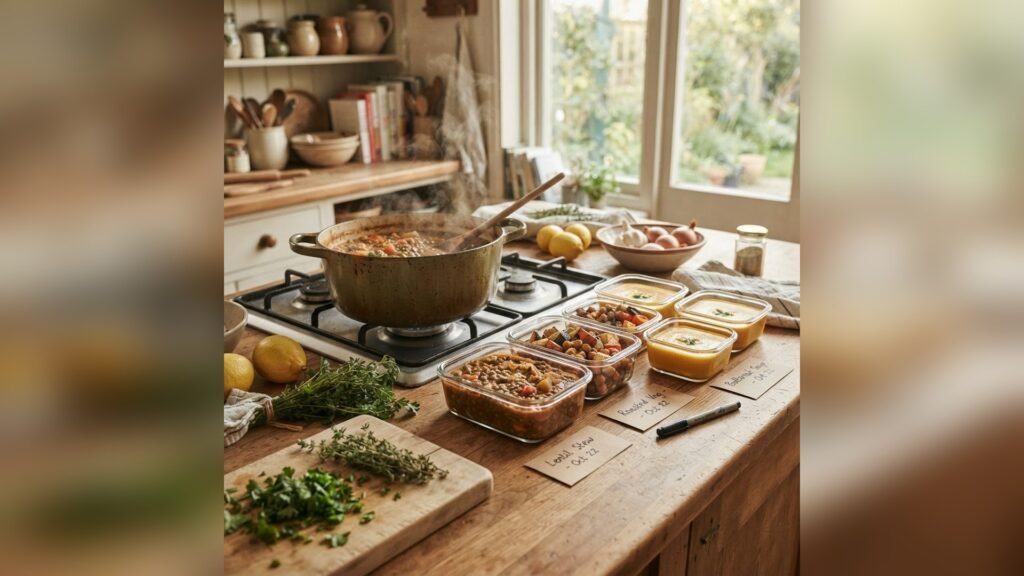
On a Sunday afternoon, a nurse named Priya does something her grandmother would recognise instantly and her younger self would have found incomprehensible: she spends two unhurried hours in the kitchen cooking food she will not eat today. A pot of dal that will become three dinners. A tray of roasted vegetables headed for the freezer. A lemon-and-lentil soup ladled into containers and labelled in a felt pen with the calm of a museum curator. By four o’clock her counter is crowded, her sink is empty, and her week — the actual week, the one with four twelve-hour shifts in it — has quietly changed shape.
Priya would not call herself a batch cooker. Like most people now doing it, she stumbled into the habit, kept it because it worked, and only later discovered it had a name, a hashtag, and an entire philosophy attached. That gap between the practice and its marketing is where the story of batch cooking in 2026 actually lives.
The problem it solves
To understand why batch cooking spread, it helps to look honestly at what it replaced. The evening meal decision — made at six-thirty, hungry, tired, with a fridge full of ingredients that each require initiative — is one of the most expensive decisions a household makes, and it is made at the worst possible hour of the day. Decision science has documented for years what every working person knows: the quality of choices collapses with fatigue. Into that collapse flows food delivery, exhausted grocery spending, sad pasta for the third time in a week, and the particular low-grade misery of eating badly while feeling like a failure about it.
The scale of the drain would be comic if it were not so relatable. Australian households now throw out astonishing quantities of food annually — much of it produce purchased with good intentions and forgotten in the crisper while the delivery app did the actual cooking. The pattern repeats across most wealthy countries: more food coming into the house than going into meals, and more money going to convenience than to the food itself. Batch cooking, at its core, is a rebellion against that pattern. It moves the decision about dinner to Sunday, when there is still enough decision-making left in the tank to make a good one.
This is why the habit has proved stickier than most food trends. It is not a diet; nothing is forbidden. It is not an aesthetic, whatever the perfectly stacked freezer shelves of the internet suggest. It is administrative — a scheduling decision about when thinking gets done — and administrative changes, once they make life measurably lighter, tend to survive.
What it actually looks like
The popular image of batch cooking is industrial: a wall of matching containers, twenty-one identical meals, a weekend consumed by preparation. It is one version of the truth, and a minor one. For most households, batch cooking is looser and more forgiving: two or three anchor dishes cooked large on one afternoon, some eaten as leftovers and some frozen, supplementing whatever fresh, fast cooking happens on the spot.
The recipes that reward batching have a personality in common. Soups, braises, curries and stews — dishes that improve on a second day, that survive freezing gracefully, that forgive imprecise seasoning at the end of a long shift. A pot of ragù is four dinners wearing a trench coat. A dal at scale is nearly free money by the third bowl. Alongside the mains sits a quieter repertoire of supporting infrastructure: a jar of dressing that turns any vegetable into a salad, a sauce base waiting in the freezer to convert a bag of groceries into Tuesday, a tray of roasted chickpeas that upgrades a lunch from adequate to good.
The freezer, once the least glamorous appliance in the house, has been quietly rehabilitated as the engine room of the modern kitchen. People who grew up associating frozen food with disappointment have rediscovered what their grandmothers never forgot: that a stocked freezer is a wardrobe, not a tomb — a place where components wait to be assembled, not meals surrender to time. It is telling that the most-used kitchen accessories of the past few years have been unglamorous: labels, markers, stackable containers, silicone bags. The tools of an archive, because that is what a working freezer has become.
The economics of a Sunday afternoon
Follow the money, and batch cooking is one of the more quietly effective financial habits a household can adopt — not because the ingredients are exotic, but because of what it displaces. Every dinner in the freezer is a dinner that does not arrive on the back of a scooter with a delivery fee attached, and does not get assembled, half-heartedly and expediently, from an expensive corner shop. The savings arrive on both sides of the ledger: less spent on food that is designed to be convenient, and less food discarded because the week got away from the plans.
There is an even less visible economy in the ingredients themselves. Batch cooking rewards a particular shopping posture — buying in quantity, buying what is in season, buying the whole chicken rather than the fillets — because it creates the scale that makes cooking from scratch rational. A person cooking one dinner at a time buys like a consumer. A person cooking six buys like a small restaurant, and gets a small restaurant’s margins. The financial character of the household kitchen changes not through virtuous restraint but through a structural shift: waste stops being a by-product and starts being visible, because it gets weighed against the week it was meant to feed.
Small households, once the hardest case for home cooking, have become batch cooking’s most natural constituency. Solo dwellers — the fastest-growing household type in most cities — have always faced brutal per-meal economics: recipes written for families, ingredients sold in family sizes, and no one to share the washing up. Cooking once and eating across the week fixes the arithmetic, turning a single person’s kitchen from a place of constant small effort into something closer to a personal canteen. The trend has even taken on a social shape, as batch clubs — small groups who cook together monthly and divide the spoils — turn the solitary chore into something between a dinner party and a courier service, with better food than either.
The calmer kitchen
But the most commonly cited reason, once the habit is established, is not financial at all. Ask people who kept batch cooking what they like about it, and the answer, almost always, is a feeling word. Calm. The week lifts. There is a particular lightness in opening the fridge on a Tuesday evening and finding that dinner has already considered your existence.
There is also a slower pleasure on the production side that the productivity framing of the habit entirely misses. The Sunday batch session, for the people who keep the ritual, has become one of the remaining islands of activity in a week otherwise made of screens — hands busy, mind unburdened, something tangible and good accumulating on the stove. It looks a lot like the quiet Sunday cooking that existed before the word “meal prep” did, and its reappearance is part of the broader migration back toward offline hobbies and slower mornings: the rediscovery that some of the old rhythms were not drudgery, but ballast.
Listen to how people describe the session and a pattern emerges that sounds nothing like utilitarian food management. The radio on. A family kitchen with children being handed the low-stakes jobs. Two flatmates splitting the cooking and the week’s logistics at the same time. For all its scheduling logic, batch cooking has reacquired a social role that the convenience era stripped out of eating: the shared, unhurried production of a common good, converted into time for each other later in the week.
A habit with an appetite for the future
None of this has escaped the wider food system, which has begun to rearrange itself around the assumption that households cook this way now. Recipes are increasingly written for scale rather than for two, with freezing notes beside the timings. Grocers promote multipacks to shoppers they once assumed were cooking only tonight. Freezer design, container design and even supermarket layouts have tilted toward the weekly pantry rather than the daily basket. The appliance that spent forty years declining in prestige has become a lifestyle purchase.
Whether batch cooking is a durable change or a pendulum swing is probably the wrong question. The deeper truth underneath it — that households will always seek to move hard thinking away from tired evenings, and that the cheapest place to buy back time is Sunday afternoon — is not going anywhere. Delivery solved the same problem by charging for it monthly; batch cooking solves it by spending an afternoon that has the energy to spare. In the long negotiation between convenience and intention that every kitchen hosts, the freezers of 2026 suggest the pendulum has swung, for now, toward intention.
For Priya, the four shifts get no shorter and the week gets no lighter. But on the hardest days, arriving home past nine to a kitchen that has already decided the answer to dinner, the difference is hard to overstate — and impossible to buy. Two hours on Sunday, compounded into thirty rescued evenings.