
A perspective piece from The Listening Market
There was a time when talking to a device felt like a novelty. A party trick. Something to show off to guests before the novelty wore off and the voice assistant went back to sitting silently on the kitchen counter, untouched for weeks. That time has quietly passed. Voice assistants are no longer something to show off. They are something to rely on. And that shift happened so gradually that most people barely noticed it happening.
The change is not about the technology itself getting dramatically smarter, although it has. It is about the way people have learned to use it. Not as a conversation partner, not as a replacement for human interaction, but as a small, frictionless layer of help woven into the rhythms of an ordinary day. Setting an alarm while half-asleep. Asking about the weather while pulling on a coat. Adding milk to a shopping list with hands full of groceries. These are not revolutionary acts. But they are acts that, taken together, add up to something that feels genuinely different from life a decade ago.
From Novelty to Utility
The early days of voice assistants were defined by disappointment. The devices could hear, but they could not really understand. Ask a follow-up question and the context was gone. Request a specific song and get something vaguely related instead. The gap between what the technology promised and what it delivered was wide enough to breed cynicism. Many people wrote voice assistants off entirely, filing them alongside 3D television and the smart fridge as ideas that sounded good in a keynote and fell flat in a living room.
But the technology kept improving, quietly and persistently. Better natural language processing meant fewer misunderstandings. Improved context handling meant follow-up questions started to make sense. Faster response times meant the lag between asking and answering shrank to the point where it stopped feeling like talking to a machine and started feeling like talking to something that was, if not intelligent, at least competent.
The bigger shift, though, was in human behaviour. People stopped trying to have conversations with their voice assistants and started treating them as tools. Specific, purposeful, transactional. Not “what do you think about the weather today?” but “will it rain this afternoon?” Not “tell me about Italian food” but “set a timer for twelve minutes.” The interaction model narrowed, and in narrowing, it became more useful. Nobody expects a hammer to hold a conversation. They just want it to hit nails.
The Kitchen Is the Centre
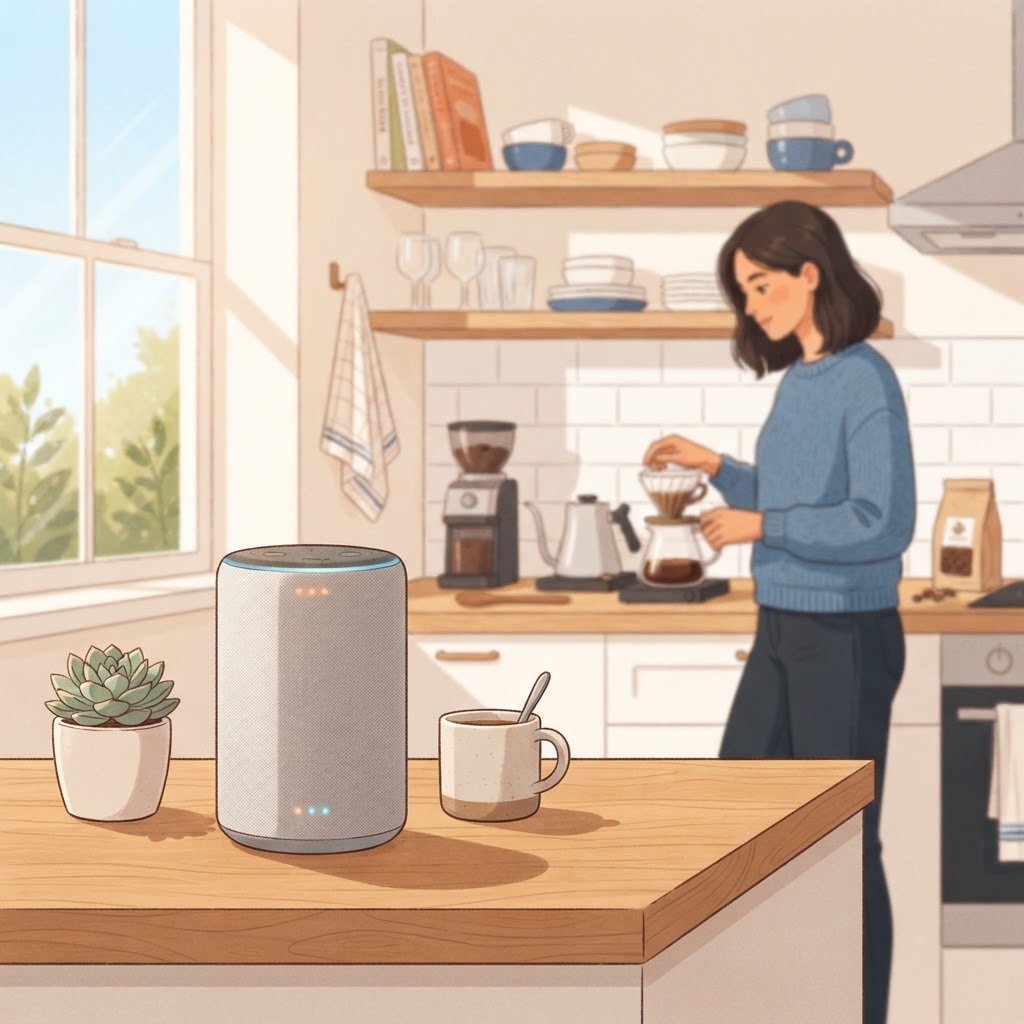
If there is one room where voice assistants have embedded themselves most deeply, it is the kitchen. This makes sense. Cooking is a hands-busy, eyes-busy activity, and voice is the only input method that works when fingers are covered in flour and attention is fixed on a simmering pot. Setting timers, converting measurements, answering questions about whether baking soda and baking powder are the same thing — these are small tasks that voice handles well, and that kitchen dwellers have learned to delegate.
But the kitchen role has expanded. Voice assistants now read out recipes step by step, keeping pace with the cook. They manage multiple timers simultaneously, each one labelled. They suggest substitutions when an ingredient is missing. They play music, because cooking without music is a lesser experience, and they do it without requiring a clean hand to tap a screen. The kitchen has become the place where voice technology is most natural and most invisible, which is exactly what good tools should be.
Beyond the Kitchen
The living room is the next frontier, and it is already being settled. Voice assistants control televisions, adjust lighting, manage thermostats, and interface with an expanding ecosystem of smart home devices. The promise of the smart home — always more compelling in theory than in practice — has started to deliver on its word, and voice is the remote control that makes it work. Not because voice is the most precise way to adjust a thermostat, but because it is the most convenient way when the alternative is finding a phone, opening an app, and tapping through menus.
Bedrooms have become voice territory too. Alarm management is the obvious use case, but there is also the growing habit of falling asleep to ambient sounds, white noise, or guided relaxation, all triggered by voice. Morning routines increasingly begin with a spoken query about the day’s schedule, the weather, or the news headlines. These are not life-changing interactions. But they are friction-reducing ones, and friction is the enemy of a smooth morning.
The Privacy Question
None of this happens without a cost, and the cost is privacy. A device that listens is a device that could be listening. The major voice assistant platforms have invested heavily in on-device processing, meaning some queries are handled locally without being sent to the cloud. This is a meaningful improvement, but it does not eliminate the fundamental tension. The convenience of a voice assistant comes from its always-on nature, and always-on means always-listening, at least technically.
Most people have made their peace with this trade-off, or at least have chosen not to think about it too carefully. The utility outweighs the discomfort, and the discomfort is abstract enough to ignore. But it is worth acknowledging that the quiet revolution of voice assistants is also a quiet revolution in the normalisation of ambient listening. The devices in kitchens and bedrooms are not malicious, but they are present, and their presence represents a shift in what people consider an acceptable level of surveillance in their own homes. This is not an argument against voice assistants. It is an observation that every convenience carries a cost, and the cost of this one is worth noticing.
Who Gets Left Behind
There is also the question of accessibility. Voice assistants are, paradoxically, both more and less accessible than traditional interfaces. For people with mobility impairments, voice can be liberating — a way to control devices and access information without needing to reach, tap, or type. For people with speech impairments, strong accents, or non-standard speech patterns, voice can be frustrating or exclusionary. The technology has improved in this area, but the improvement is uneven, and the people most likely to be left behind are often the people who would benefit most from a hands-free interface.
This is not a problem that market forces alone will solve. The largest user groups get the most attention, the most training data, the most refinement. Smaller groups, especially those whose speech differs from the norm, face a gap that narrows slowly if it narrows at all. It is worth remembering that a quiet revolution is only revolutionary for the people who get to participate in it.
The Next Phase
The future of voice assistants is less about voice and more about integration. The standalone smart speaker will not disappear, but it will become less central as voice capability spreads across devices — phones, watches, cars, appliances. The question “which device has the voice assistant?” will become increasingly meaningless because the answer will be “all of them.” What will matter is which device is closest, which context is most relevant, and which interaction feels most natural in the moment.
This is the quiet part of the quiet revolution. Not a dramatic change in capability, but a diffusion of capability across the surfaces of daily life. Voice becomes less a feature and more an assumption. Less something to think about and more something to use without thinking. That is the trajectory, and it is well underway.
There is something fitting about this. The most successful technologies are the ones that disappear into routine. Electricity did not stop being revolutionary because people stopped marvelling at it. It became more revolutionary, not less, when it became invisible. Voice assistants are on a similar path. They are past the novelty stage, past the disappointment stage, and deep into the integration stage. They are not changing the world with a bang. They are changing it with a murmured “set a timer for twelve minutes” while someone stirs a pot. And that, in its own quiet way, is how real change tends to happen.