
A perspective piece from The Listening Market
There was a time, not so long ago, when running a household or a small business meant spending entire evenings on paperwork. Receipts to sort. Spreadsheets to update. Appointments to reschedule by phone, one at a time, listening to hold music and repeating details to a receptionist who would type them into a system that seemed designed to lose them. Admin was the invisible tax on modern life, the dull machinery that kept everything turning but consumed hours that could have been spent on almost anything else.
Something has shifted. It is hard to say exactly when, because it did not arrive with a fanfare or a single product launch. There was no morning when the world woke up and declared that admin was over. Instead, it faded, the way a persistent background noise gradually becomes silence. Tasks that once demanded an hour of focused attention now take a few seconds. Decisions that required comparing five tabs and a spreadsheet are handled with a single question. The administrative burden has not disappeared entirely, but it has shrunk, and the thing doing the shrinking is artificial intelligence.
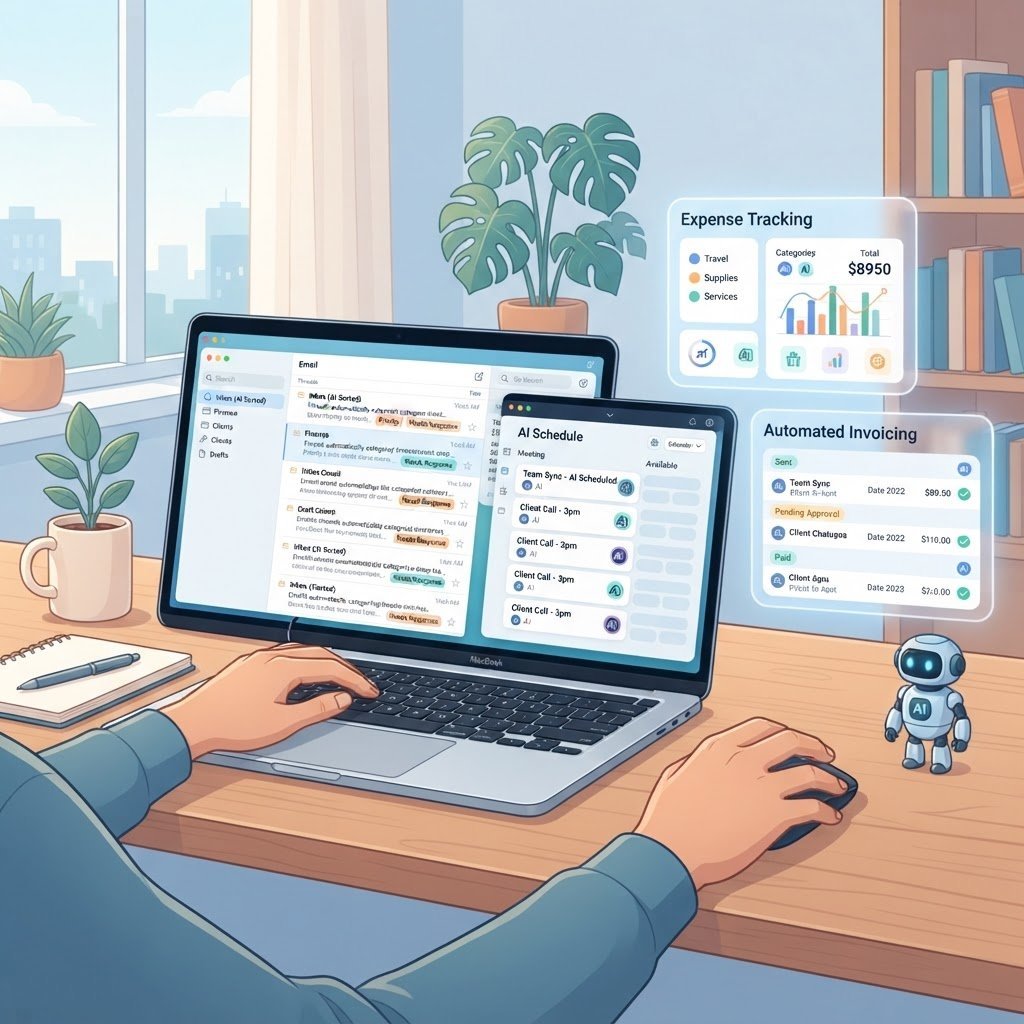
Consider the simple act of scheduling. For years, arranging a meeting between two busy people meant a chain of emails. Does Tuesday work? How about Wednesday afternoon? That time does not suit, could we try next week? Each exchange added friction, and by the time a slot was found, the mental energy required to prepare for the actual conversation had already been spent. AI-powered scheduling tools have changed this. A calendar assistant can read availability, propose times, send invitations, and handle rescheduling without any human intervention. The meeting appears on the calendar as if by magic, and the back-and-forth simply never happens.
Then there is the matter of expenses and receipts. The old routine involved a shoebox, a calculator, and a sense of dread. Every receipt had to be matched to a transaction, categorised, and entered into a system. For small business owners, this was a monthly ritual that ate entire evenings. Now, a phone camera and an AI-driven app can capture a receipt, extract the relevant data, categorise the expense, and sync it with accounting software. The receipt is read, understood, and filed in the time it takes to snap a photograph. The shoebox has become obsolete.
Email, that great generator of administrative overhead, is also being tamed. The average professional receives dozens of messages a day, many of them requiring some form of response or action. AI assistants embedded in email platforms can now draft replies, summarise long threads, highlight what needs attention, and even surface follow-up reminders when a sent message goes unanswered. The inbox has not disappeared, but it has become quieter, more manageable, less of a daily assault. The mental load of keeping track of who said what and what still needs doing is being quietly absorbed by systems that never forget.
Bill management is another area where the friction has dissolved. Utility bills, subscription charges, insurance renewals. These used to require vigilance. A missed payment could mean a late fee or a lapsed policy. Comparison shopping for better rates meant hours on comparison websites, reading fine print, and making spreadsheets. AI tools can now monitor recurring charges, flag price increases, suggest alternative providers, and even automate the switching process. The tedious vigilance that financial responsibility once demanded is being handed off to something that does it better and never tires.
For small business owners, the transformation is even more pronounced. Invoicing, once a manual process of creating documents, sending them, tracking payment, and sending reminders, can now be largely automated. AI can generate invoices from timesheets or project data, send them on schedule, detect when payment is overdue, and issue polite but firm reminders without any human prompting. Customer relationship management, which used to mean a database that someone had to manually maintain, can now auto-populate with data pulled from emails, calls, and meetings. The business runs more smoothly because the administrative scaffolding is holding itself up.
Even the seemingly simple act of booking a service has changed. Need a plumber, a hairdresser, a dentist appointment? The old way meant calling during business hours, waiting on hold, and hoping the available slots aligned with a busy schedule. Now, AI-powered booking systems handle it around the clock, finding openings, sending confirmations, and managing cancellations. The friction of coordination, which once made even simple tasks feel like chores, has been smoothed away.
What makes this shift remarkable is its quietness. There was no single product that promised to eliminate admin. Instead, AI capabilities have been woven into existing tools, appearing as features inside apps that people already use. A smart reply suggestion in an email client. An automatic categorisation in a banking app. A scheduling link that handles the logistics of finding a time. Each individual feature seems minor, but together they represent a fundamental reduction in the amount of mechanical, repetitive work that fills an average day.
The implications extend into the personal realm as well. Booking a restaurant, planning a trip, organising a household budget, tracking subscriptions, managing a move. These are the admin tasks of private life, the ones that eat evenings and weekends. AI assistants can now handle restaurant reservations through natural language requests, pull together travel itineraries from scattered confirmations, flag subscriptions that have not been used in months, and generate moving checklists tailored to a specific timeline and location. The mental space that these tasks once occupied is being freed up, not because the tasks have been eliminated but because they no longer require a human to manually execute each step.
There is something else happening too, something subtler. As admin shrinks, the threshold for doing things lowers. Tasks that once felt like too much effort, like comparing insurance providers or renegotiating a phone bill, become feasible because the effort involved has dropped dramatically. People are making better decisions not because they have become more diligent but because the cost of diligence has fallen. An AI tool that compares plans in seconds and presents the best option turns a chore into a quick check. The result is not just saved time but better outcomes, decisions that were always possible but rarely acted upon because the admin was too heavy.
There is a broader implication here that is worth pausing on. When admin shrinks, time expands. The hours that used to go into sorting, filing, scheduling, and chasing are suddenly available for other things. For some, that means more time for actual work. For others, it means more time for family, for rest, for the parts of life that administrative tasks were always crowding out. The promise of technology has long been that it would save time, and for years that promise felt hollow, because each new tool seemed to create as much work as it removed. AI feels different because it is taking on the work that no one ever wanted to do in the first place.
Of course, this transition is not without its complications. When an AI assistant drafts an email, there is a question of authenticity. When it categorises an expense, there is a question of accuracy. When it schedules a meeting, there is a question of whether the chosen time suits the human beings involved, not just their calendars. These are real concerns, and they require a degree of oversight that itself becomes a new, smaller form of admin. But the net reduction in effort is undeniable, and as the tools improve, the need for correction diminishes.
There is also a question of dependence. When admin is handled automatically, people risk losing the habit of staying on top of their own affairs. If a scheduling tool fails, or an expense app misclassifies a transaction, the person who once would have known their own calendar inside out may find themselves oddly unfamiliar with their own schedule. This is the trade-off that accompanies every labour-saving technology, from the washing machine to the calculator. The convenience is real, but so is the loss of a certain kind of hands-on awareness.
Still, it is hard to argue against the direction of travel. The administrative tasks that AI is absorbing were never fulfilling. They were necessary, yes, but they were the kind of necessary that drained rather than enriched. No one finished a session of receipt sorting and felt a sense of accomplishment. No one came away from an hour of email triage feeling creatively energised. These were the chores of modern life, the digital equivalent of washing dishes, and like dishwashers before them, AI tools are simply doing them so that people do not have to.
The quiet disappearance of admin is not a headline trend. It does not trend on social media or dominate conference keynotes. But it may be one of the most meaningful ways that AI is changing everyday life. Not by doing extraordinary things, but by removing the ordinary ones. The hours that come back are small, scattered, almost invisible individually. But add them up across a week, a month, a year, and they amount to something significant: a life with a little more room in it.
That, perhaps, is the most honest measure of what AI is doing right now. Not replacing people, not transforming industries overnight, but quietly clearing away the clutter. One scheduled meeting, one categorised receipt, one drafted email at a time. The admin is fading, and what remains is time.




