
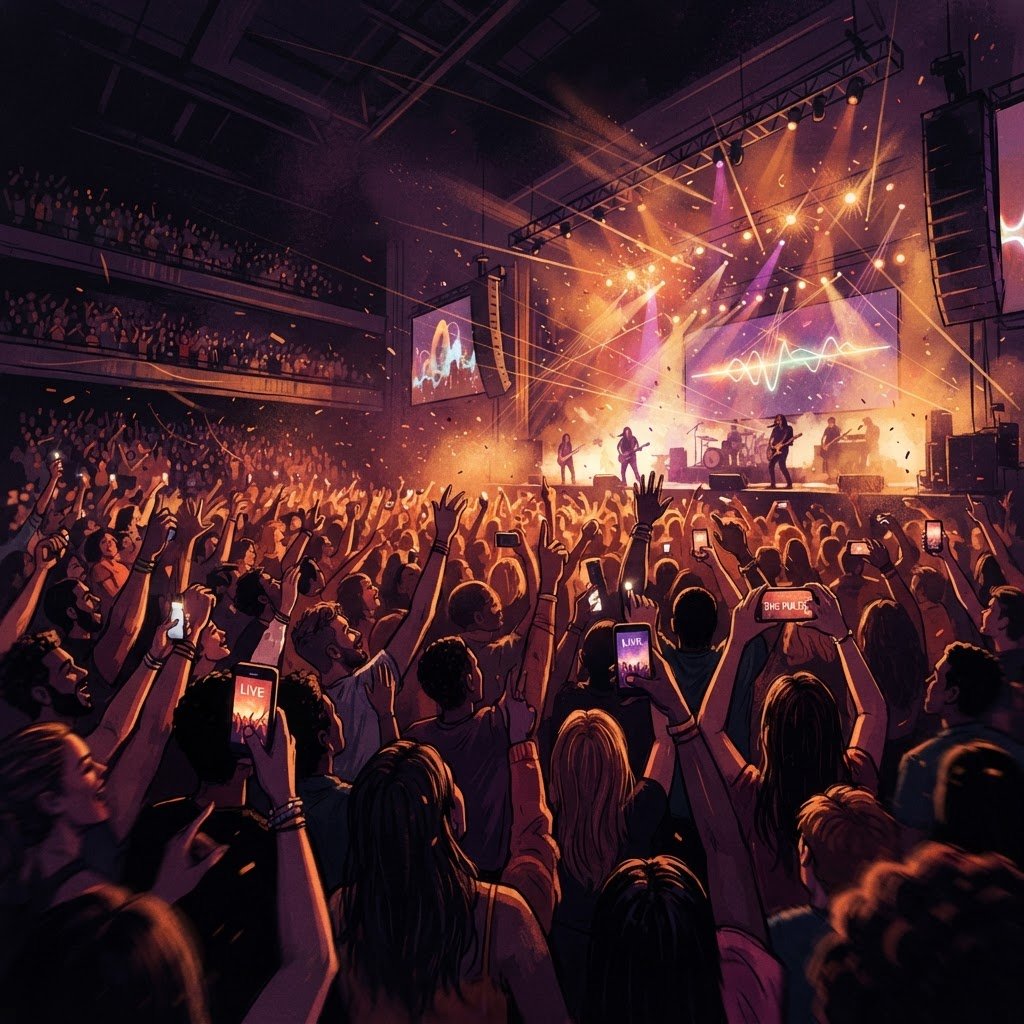
A perspective piece from The Listening Market — Imagine standing in a darkened arena just as the house lights fall. A wave of collective anticipation ripples through thousands of strangers. In that precise second, nobody is checking notifications, toggling between browser tabs, or adjusting playback speeds to save time. Before the first guitar chord rings out, the theater curtain rises, or the stage lighting ignites, time ceases to feel fragmented. In a culture where virtually every form of entertainment can be streamed, downloaded, or synthetically generated in seconds, an unexpected shift has taken hold of the global cultural landscape. The more abundant digital media becomes, the more deeply people hunger for physical reality. Across music halls, theater auditoriums, stadium seats, and intimate community venues, live experiences in a digital world are no longer viewed as mere options for evening leisure. They have transformed into vital sanctuaries of presence, shared emotion, and irreplaceable human connection.
The Paradox of Frictionless Culture
For the past two decades, the global entertainment landscape has operated under a single dominant philosophy: the elimination of friction. Streaming services brought millions of songs to pocket-sized devices. High-definition screen technology brought stadium-level visuals into quiet living rooms. On-demand algorithms eliminated the need to wait for weekly radio broadcasts or hunt through dusty record bins. Convenience became the ultimate metric of cultural progress.
Yet, convenience carried a subtle and profound trade-off. When access to art becomes completely effortless, individual cultural moments often lose their weight. A track that can be skipped in half a second rarely commands the reverence of a vinyl record carefully placed onto a turntable. A film streamed while casually scanning a smartphone lacks the singular hold of a darkened cinema. When everything is perpetually available at zero physical cost, nothing feels scarce, and without scarcity, emotional resonance can easily diminish.
This dynamic explains why physical presence has regained its status as a cornerstone of human value. Attending a live event inherently demands friction. It requires securing a ticket, coordinating schedules, navigating evening traffic, stepping out into unpredictable weather, standing shoulder-to-shoulder among crowds, and committing dedicated hours to a single physical location. Far from being a deterrent, this friction is precisely what invests live gatherings with lasting meaning. The physical effort expended converts the event from passive content consumption into an intentional act of devotion. In an era where digital life feels weightless, physical effort creates emotional gravity.
Collective Effervescence: The Shared Room
Solitary media consumption has reached an all-time peak, yet human psychology remains fundamentally wired for communal reflection. Sitting alone in a room with noise-canceling headphones offers flawless acoustic fidelity, but it cannot replicate the sensation of thousands of voices singing the exact same chorus in unison. That visceral sensation has a rich history in human sociology and anthropology.
In his landmark 1912 sociological study, The Elementary Forms of Religious Life, French sociologist Émile Durkheim introduced the concept of “collective effervescence.” Durkheim used the phrase to describe the intense energy and heightened sense of unity that occurs when a group of individuals gathers in physical proximity to share a single focus and collective emotion. During these moments, personal boundaries soften, individual anxieties recede, and participants feel swept up in something significantly larger than themselves.
Modern audiences experience this exact phenomenon when attending a concert, a theatrical performance, or a high-stakes athletic match. When a performer reaches a dramatic climax and the crowd gasps or cheers together, a shared electrical impulse passes through the entire room. This collective effervescence satisfies a fundamental psychological need that screens simply cannot fulfill. Digital platforms connect individuals across vast geographic distances, yet they frequently leave people feeling isolated in front of glowing glass. Physical gatherings bridge that emotional void, offering a rare and comforting reminder of shared humanity.
The Unscripted Imperfection of the Living Stage
In a digital ecosystem increasingly dominated by hyper-polished production, autotune, and algorithmic precision, technical perfection has lost much of its novelty. Social media feeds display carefully curated highlights, while generative tools can now produce pristine audio tracks and hyper-realistic visual art in moments. When perfection becomes cheap and automated, human imperfection becomes priceless.
The magic of live performance lies precisely in its unpredictability and vulnerability. A live stage is a high-wire act with no safety net, edit button, or secondary take. An actor might pause a fraction of a second longer than rehearsed, imbuing a famous monologue with unexpected grief. A musician might improvise a solo, leaning into a spontaneous burst of inspiration that was never captured on the studio recording. A dancer might land on stage with a resonant thud, revealing the immense physical strain required to make movement appear weightless.
These subtle moments of uncertainty remind audiences that they are witnessing living human beings operating at the outer edge of their capability. The constant potential for mistake, surprise, or brilliant spontaneous revelation gives live events their electrical tension. Audiences do not gather merely to hear notes played accurately; they gather to witness living truth unfold in real time. In a world saturated with synthetic polished content, the vulnerable reality of the stage offers a rare breath of authenticity.
Reclaiming Focus in a Fragmented World
Modern life is defined by constant cognitive fragmentation. Notifications, short-form video feeds, and multi-screen environments have trained human attention to jump perpetually from one stimulus to another. Deep, sustained focus has become one of the rarest mental states to maintain in daily life.
Live events enforce a sacred and necessary boundary around human attention. When the house lights dim in an auditorium or concert hall, a tacit social agreement takes effect among everyone in the room. For two hours, the outside world is put on pause. Smartphones are tucked into pockets or sealed in quiet pouches, bright displays disappear, and the entire room yields to a single focal point.
This forced focus provides a profound sense of psychological relief. In a culture where attention is relentlessly auctioned off to the highest digital bidder, surrendering attention entirely to a live performance feels like a restorative act of rebellion. The mind is allowed to settle into a single narrative arc, feeling every swell, quiet whisper, and sudden pause without digital interruption. This deep immersion enables art to hit with far greater emotional impact than when media is consumed while multitasking across multiple devices.
Multi-Sensory Memory and Acoustic Reality
A digital screen, regardless of its resolution or visual clarity, appeals primarily to two senses: sight and sound. Furthermore, those senses are engaged through flat, uniform mediums—smooth glass surfaces and small speakers. The sensory profile of digital media remains fundamentally flattened and compressed.
Live experiences, by contrast, engage the entire physical nervous system. A live concert is felt physically through the chest as sub-bass vibrations ripple across floorboards and stadium benches. Theater involves the scent of wooden stagecraft, costume textiles, and aged velvet seating. Outdoor music festivals carry the cooling evening air, the scent of summer earth, and the shifting colors of natural twilight.
Neuroscience consistently demonstrates that multi-sensory physical experiences create far stronger, more enduring memory pathways in the human brain. While someone may struggle to recall which short videos were scrolled through yesterday evening, memories of a concert or theatrical production attended years ago often remain vivid and emotionally charged. The brain retains the tactile reality of the room, the warmth of the crowd, and the resonance of physical acoustics. Live experiences in a digital world offer rich sensory texture in an increasingly sanitized and frictionless digital environment.
Ephemerality as the Ultimate Contemporary Luxury
In the digital realm, almost everything is archived. Videos are uploaded to cloud servers, audio broadcasts are preserved for instant streaming, and discussions are recorded in endless digital threads. This infinite archivability creates a subtle impression that nothing is ever truly lost, but it also strips moments of their natural urgency. If an event can be replayed at any hour of any day, there is no pressing reason to treasure the living present.
A live experience is inherently ephemeral. Even if a concert or play is recorded on smartphones, the actual physical moment exists only once. The specific blend of room temperature, crowd energy, performer mood, and spontaneous audience interaction will never align in the exact same configuration again. When the final bow is taken or the house lights return, that exact moment vanishes into history.
This temporary nature makes live events the ultimate luxury of the modern age. In a culture saturated with endless digital copies, an unrepeatable experience cannot be mass-produced, duplicated, or stored on a hard drive. It lives solely in the memories of those who were present in the room. This impermanence imbues every second on stage with heightened emotional value.
The Resilience of Live Experiences in a Digital World
Recognizing the value of physical gathering does not require rejecting digital progress. Digital platforms have democratized access to music, drama, and artistic education in ways that were unimaginable a generation ago. An aspiring listener living in a remote rural town can explore world-class symphonies, independent theatre productions, or global musical traditions with unprecedented ease.
However, digital distribution functions best not as a replacement for live experiences, but as a gateway to them. Digital channels enable discovery, while physical gatherings provide ultimate fulfillment. The digital world spreads the initial spark, but the physical world ignites the enduring fire. As digital tools become even more pervasive, intelligent, and immersive, the distinction between synthetic media and living reality will only become clearer.
Far from rendering physical venues obsolete, the digital age has illuminated their true and enduring purpose. Live events are not merely commercial entertainment products; they are essential human rituals that anchor culture. They remind people of what it feels like to share a room with strangers, to be captivated by raw human talent, and to belong to a living, breathing collective.
As the world continues to navigate an increasingly digital future, the impulse to gather in physical light and sound will only grow stronger. Live experiences in a digital world stand as a powerful testament to an enduring truth: no matter how advanced technology becomes, nothing can replace the transformative power of being there.