A perspective piece from The Listening Market
At a quarter past eight in the evening, a sleeper train pulls out of a capital city station and glides past the lit windows of suburbs sliding into darkness. By dawn it is winding through mountains, and in the dining car a traveller is eating eggs with actual cutlery while the valley tilts below. Twenty minutes after arrival, that traveller walks out of a city-centre station directly into a meeting, rested, unjetlagged and carrying a water bottle that passed no security check in three countries. Somewhere above, at that same hour, the equivalent flight is taxiing on the tarmac through the third queue of its journey. A quiet shift has been building for years in how people move between cities, and 2026 is the year it stopped being a niche preference and started showing up in booking data: for a growing share of travellers, the train is no longer the sentimental alternative. It is simply the better decision.
Door-to-door arithmetic
The case begins with a piece of accounting airlines have always quietly benefited from: the ticket measures only the flying part. A short-haul flight consumes far more of a day than its 90 minutes in the air. Travel to the airport, because airports are built far from where people live. Check-in windows, security queues, gates that demand a twenty-minute walk, baggage belts, and an hour from the remote terminal into the city at the other end. The fastest way to travel 600 kilometres has habitually meant three hours of standing in lines around it.
The train reverses most of that arithmetic, because it was designed around the opposite principle: stations sit in the middle of cities, the boarding process is closer to a bus than a border crossing, and the seat is generous enough to make the journey itself usable. Laptop tables, phone signal, the freedom to stand up and walk to a cafe car mid-journey — the hours aboard a train are among the few travel hours that can be spent working, eating or sleeping without apology. For distances under a few hundred kilometres, high-speed rail now routinely beats the plane on total door-to-door time, a fact that has begun to reshape short-haul aviation itself, with several European countries restricting or taxing short domestic flights precisely because the train wins them anyway.
Rails are having a renaissance
The supply side rediscovered demand first. Sleeper networks that were nearly shut down a decade ago have been rebuilt and expanded, with new overnight routes connecting cities that lost their railways generations ago, plus private operators reviving classic trains with modern service and, crucially, prices aimed at normal travellers rather than nostalgists. New high-speed corridors keep opening across Europe and Asia, and bookings have answered. Rail’s share of medium-distance travel keeps climbing in markets from Spain to Japan, and the new entrants arriving on open-access routes have brought fares down at the same time.
Australia plays its own version of the story. The enormous distances compress the map less gracefully than Europe’s, but the pattern rhymes: regional and interstate services are carrying noticeably more leisure travellers, heritage and scenic lines have waiting lists, and the slow transcontinental journeys that were once written off as novelty trips are now booked solid seasons ahead — sold as the experience they always secretly were. There, as elsewhere, the train stopped competing with the plane on speed and won on something else.
The climate generation’s quiet choice
Values are doing their part in the background. A modest but growing share of travellers, younger travellers most visibly, treat flying as something to be budgeted carefully and used deliberately rather than defaulted to. Some take the pledge of a flight-free year. Many more simply nudge individual decisions toward the platform, and the rail operators have noticed exactly who is booking: the overland-and-overnight share skews younger than the airline’s by a full generation. That generation reached adulthood with aviation’s emissions as household knowledge, and it has rediscovered a mode of travel that was sitting there all along with a fraction of the footprint per passenger kilometre.
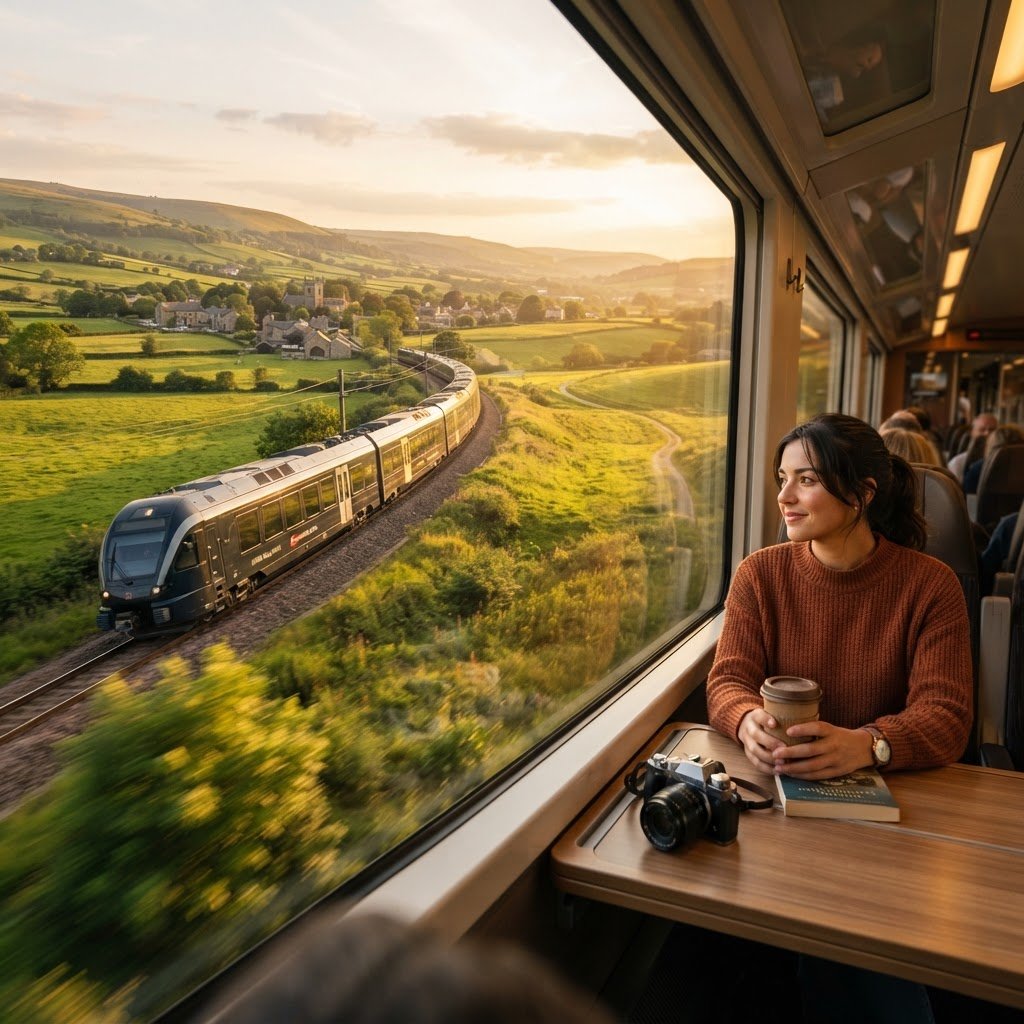
The aesthetic case drifted in with the ethical one. Slow travel photographs beautifully: window seats with mountain light, dining cars, platforms at dawn. The journey became the kind of experience worth documenting rather than the dead time to be endured before one begins. A trip by rail can be posted from the middle of the journey; a trip by plane can only be posted from either end.
The work-anywhere economy tilted the balance
Something else changed in the traveller, not the train. As remote and hybrid work spread, the ability to use travel hours productively stopped being a luxury and became an expectation, and the train turned out to be the mode of travel that remote work actually works on. A full table, signal, room for a coffee that is not sealed shut; four hours of a regional journey can absorb a morning of calls and email in a way a middle seat at 10,000 metres cannot pretend to offer. An overnight train with a cabin is, functionally, a moving hotel room that saves a night’s accommodation and the morning taxi. Some travellers now book the long way round on purpose, precisely because the journey is the only part of travel that lets time be spent twice.
The honest caveats
None of this makes the train the answer to every trip, and the rail renaissance has stubborn limits of its own. Beyond certain distances the plane simply cannot be argued with, and no amount of dining-car romance makes a 24-hour journey practical for a two-day trip. Prices on the busiest fast routes have risen with demand, sometimes embarrassingly above the equivalent flight. Booking across borders remains more complicated than it should be, with national systems that refuse to speak to one another smoothly. And reliability can still wobble with weather and industrial action, as any commuter will attest. The sensible verdict is not that flights are finished but that the automatic reflex — check flights first, trains never — has quietly expired.
The journey recovered
Beneath all the arithmetic and the emissions and the marketing runs something simpler. For half a century of mass aviation, travel was compressed into a ritual of endurance: the belt, the queue, the seat prepared for a body that was not coming. The frame of reference for every mode became the plane at its worst, and every hour not flying was an hour lost. The return of the train reflects a sharper question, asked more often every year: what if the hours in between could be reclaimed rather than merely survived?
The traveller eating eggs in the dining car as the mountains tilt past the window has already answered. The destination gets the photographs, but the train — steady, unbothered, rolling through the country it was built to connect — has quietly won back the part of travel everyone had been trying to skip.