
A perspective piece from The Listening Market
Consider two contrasting mornings. In the first, the day begins with a reluctant step into a dimly lit corner. A tangle of charging cables slithers across a scarred desk. The laptop screen reflects the harsh glare of an overhead light, and half-filled coffee mugs from yesterday sit beside a towering stack of unsorted mail. Every movement feels heavy before a single email is answered. Entering the room requires a quiet act of negotiation, a conscious summoning of willpower just to sit down.
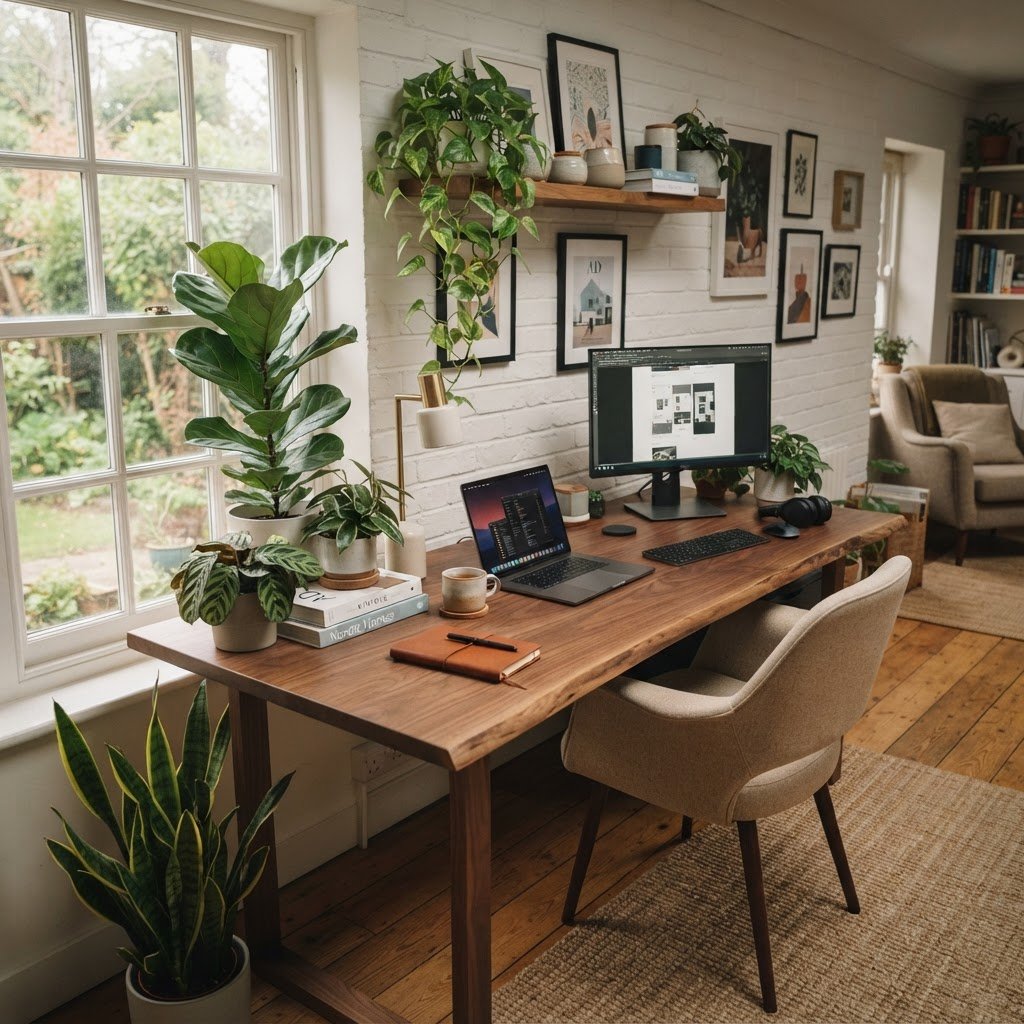
Now consider the second morning. Sunlight spills across a clean oak desk positioned perpendicular to a window. A single healthy monstera plant catches the morning light. A matte desk pad frames a streamlined workstation where every cable disappears behind clean lines. The chair invites posture without stiffness. Standing at the threshold, the mind does not brace for impact; it relaxes into readiness. There is no negotiation required. The environment itself pulls the worker forward.
The difference between these two scenarios is not wealth, square footage, or expensive designer furniture. It is environmental psychology. For decades, interior design focused on aesthetic presentation, while corporate office management prioritized spatial density. Neither approach addressed the fundamental human reality: physical surroundings dictate psychological state. When learning how to design a workspace that makes professionals actually want to work, aesthetics are merely the entryway. The true architecture of a productive environment is built on friction reduction, sensory cues, and biological alignment.
The Invisible Friction of the Daily Environment
Every environment contains hidden friction points that subtly drain mental energy throughout the day. In cognitive science, this is understood through the lens of decision fatigue and ambient cognitive load. When a desk is cluttered, the brain must continuously expend energy filtering out irrelevant visual stimuli. A landmark study published by researchers at the Princeton Neuroscience Institute demonstrated that multiple stimuli present in the visual field at the same time compete for neural representation, effectively reducing cognitive capacity and increasing susceptibility to distraction.
Visual clutter is only the most obvious offender. Micro-frictions accumulate silently across every sensory channel. A chair that requires constant adjustment, a keyboard situated at an awkward height, an outlet located just inches beyond easy reach—each small inconvenience acts as a tax on focus. Individually, these details seem trivial. Collectively, they create a sensory environment that signals resistance to the human brain.
When the mind encounters physical resistance, it naturally seeks escape. The sudden urge to check social media, tidy a kitchen, or wander into another room is rarely a failure of character or discipline. More often, it is a direct response to a physical space that feels uncomfortable or uninviting. By systematically identifying and eliminating these physical friction points, a space transforms from a hurdle into an incubator for quiet concentration.
Lighting as a Signal for Cognitive Focus
Light is the single most powerful biological signal human beings receive from their environment. It dictates circadian rhythms, regulates cortisol production, and directly influences mood, alertness, and cognitive performance. Yet lighting is frequently treated as an afterthought—a single harsh ceiling fixture or a solitary desk lamp tucked into a shadow.
To create a workspace that inspires daily engagement, lighting must be approached as a multi-layered system aligned with human biology. Natural light remains the ideal foundation. Position a desk near a window whenever possible, ideally perpendicular to the glass to maximize daylight exposure while eliminating direct screen glare. According to research published in the Journal of Environmental Psychology, workers exposed to abundant natural daylight report significantly lower levels of daytime sleepiness, reduced eye strain, and higher overall energy levels throughout the workday.
When natural light begins to fade, ambient and task lighting must step in thoughtfully. Avoid relying on a single overhead light, which casts long shadows and creates stark, institutional contrast. Instead, layer warm ambient lighting with focused task lighting. A lamp with a warm color temperature between 2700K and 3000K placed behind or beside the monitor softens the visual contrast between the glowing screen and the surrounding wall, preventing eye fatigue during late-afternoon focus sessions.
Constructing Psychological Boundaries in Open Spaces
The rise of remote and hybrid work dismantled the physical distance between professional labor and personal recovery. When a workstation sits at the end of a dining table or two feet from a bed, the psychological distinction between focus and rest blurs completely. The brain, confused by conflicting spatial signals, fails to fully commit to either state.
Solving this challenge requires establishing firm spatial boundaries, even within modest floor plans. The human mind relies heavily on environmental contextual anchors. Just as a bedroom signals sleep, a dedicated workspace must signal focused intentionality. If a separate room is unavailable, visual and physical thresholds can be constructed using room dividers, open shelving, large indoor plants, or even a distinct floor rug that marks the perimeter of the work zone.
Equally critical is the rule of single-purpose utility. When sitting at the desk, the space should be reserved strictly for deep work, strategic thinking, and creative execution. Dining, casual scroll-throughs on smartphones, and passive entertainment should happen elsewhere. Over time, this disciplined separation builds a strong psychological reflex: stepping into the work zone immediately triggers a state of mental readiness, making the transition into difficult tasks feel natural and effortless.
Ergonomics as Kinetic Freedom
The modern conversation around ergonomics often devolves into an arms race of high-tech office chairs and complex posture correctors. While a supportive chair is certainly a worthwhile investment, true physical ergonomics is less about static posture and more about kinetic freedom—the ability to shift, move, and adapt throughout the working day.
Static posture, no matter how scientifically aligned, inevitably breeds stiffness, physical fatigue, and mental stagnancy. The human body was designed for continuous variation. A workspace designed to cultivate lasting focus incorporates options for dynamic movement. Height-adjustable sit-stand desks allow for fluid transitions between sitting and standing, re-energizing circulation during long afternoons.
Key ergonomic reference points should remain intuitive rather than rigid:
- Monitors positioned so the top third of the screen sits at direct eye level, preventing neck strain.
- Keyboards and trackpads placed at a height that allows forearms to rest parallel to the floor with relaxed shoulders.
- Feet supported flat on the floor or on a stable footrest to relieve lower back pressure.
- Essential daily tools arranged within an easy arm’s reach to eliminate repetitive twisting and awkward stretching.
When physical discomfort disappears from conscious awareness, mental bandwidth expands dramatically. The body ceases to be a distraction, allowing creative attention to pour entirely into the work at hand.
Curating Sound, Touch, and Biophilic Cues
Aesthetics often dominate discussions of interior design, but human beings experience spaces through a rich symphony of senses. Sound, texture, and natural elements play an outsized role in determining whether a space feels welcoming or sterile.
Biophilic design—the practice of integrating natural elements into built environments—is one of the most thoroughly validated tools in spatial psychology. Introducing living foliage, rich natural timber, stone surfaces, and organic textiles transforms a rigid room into a grounded, restorative environment. Research published in the Harvard Business Review highlights that incorporating biophilic elements into workplace design reduces physiological stress responses, lowers blood pressure, and boosts creative problem-solving capacity.
Acoustics require equal care. Hard, reflective surfaces produce echoes and amplify ambient household noise, creating an atmosphere of subtle chaos. Soft area rugs, heavy curtains, felt desk pads, and upholstered seating absorb erratic sound waves, creating a quiet acoustic envelope. Combined with custom soundscapes—such as pink noise, binaural beats, or ambient instrumental music—the auditory landscape becomes a sanctuary where concentration thrives undisturbed.
Tactile experience completes the sensory ecosystem. The feel of solid hardwood under palm, the subtle weight of a brass pen, the smooth glide of a quality desk surface—these physical touchpoints ground the body in the physical world, offering a satisfying counterweight to hours spent inside digital displays.
Designing the Ritual of Arrival and Departure
A beautifully designed room is only as effective as the daily routines that govern it. To establish a space that consistently draws the mind into focus, the physical environment must be supported by intentional rituals of arrival and departure.
The morning arrival should feel frictionless. When walking up to the desk, the workspace should present a clean, inviting canvas. Laptops should be charged, notebooks open to a fresh page, and essential tools ready for immediate use. If the first fifteen minutes of the day are consumed by untangling wires, hunting for misplaced notes, or clearing yesterday’s trash, precious mental momentum is wasted before meaningful work begins.
This seamless arrival is made possible by a deliberate evening departure ritual. At the end of the workday, dedicate five minutes to a complete environmental reset. Close open browser tabs, clear away cups, wipe down surfaces, and write down the top three priorities for the following morning. This simple closing ceremony serves a dual purpose: it signals to the brain that the workday is officially over, allowing full psychological detachment during personal hours, and it guarantees that tomorrow begins with total clarity and ease.
Creating a Space That Works for You
Ultimately, learning how to design a workspace that makes people actually want to work is an ongoing process of observation and refinement rather than a one-time renovation. The goal is never perfection; it is alignment. An effective workspace is a living environment that responds to personal working styles, honors human biology, and respects psychological needs.
When a space is crafted with this level of intentionality, the relationship with daily labor undergoes a profound shift. The daily grind loses its harshness. Resistance gives way to momentum. Sitting down to write, build, analyze, or create no longer feels like a forced obligation—it becomes a natural, inviting ritual that professionals look forward to every single day.