
TITLE: Smart Homes in 2026: What Actually Changed and What Did Not
FOCUS_KEYWORD: smart homes 2026
SEO_TITLE: Smart Homes in 2026: What Actually Changed and What Did Not
META_DESCRIPTION: Smart home technology was supposed to change everything by 2026. Here is what actually happened, what disappointed, and what genuinely delivered.
CATEGORY: Technology
A perspective piece from The Listening Market
There was a period, roughly five or six years ago, when the promise of the smart home felt almost unbounded. Every technology company was promising a future where homes would anticipate needs before they were articulated, where lights would adjust themselves to the mood of the room, where refrigerators would order groceries autonomously, and where the entire domestic experience would be seamlessly orchestrated by a voice command or a tap on a phone. The vision was seductive, and the marketing was relentless. People bought in, literally and figuratively. Smart speakers flew off shelves. Connected light bulbs became gateway devices. Thermostats that learned preferences became status symbols of a new kind of domestic sophistication. And then reality set in, as it tends to.
Now that 2026 has arrived, it is worth taking an honest look at what the smart home has actually become. The picture is more nuanced than the utopian visions suggested, but it is also more interesting. Some of the promised transformations have genuinely arrived, quietly and without fanfare. Others remain stubbornly incomplete, hampered by practical limitations that the hype cycle chose to ignore. And a few have turned out to be things nobody asked for, solutions in search of a problem that did not exist.
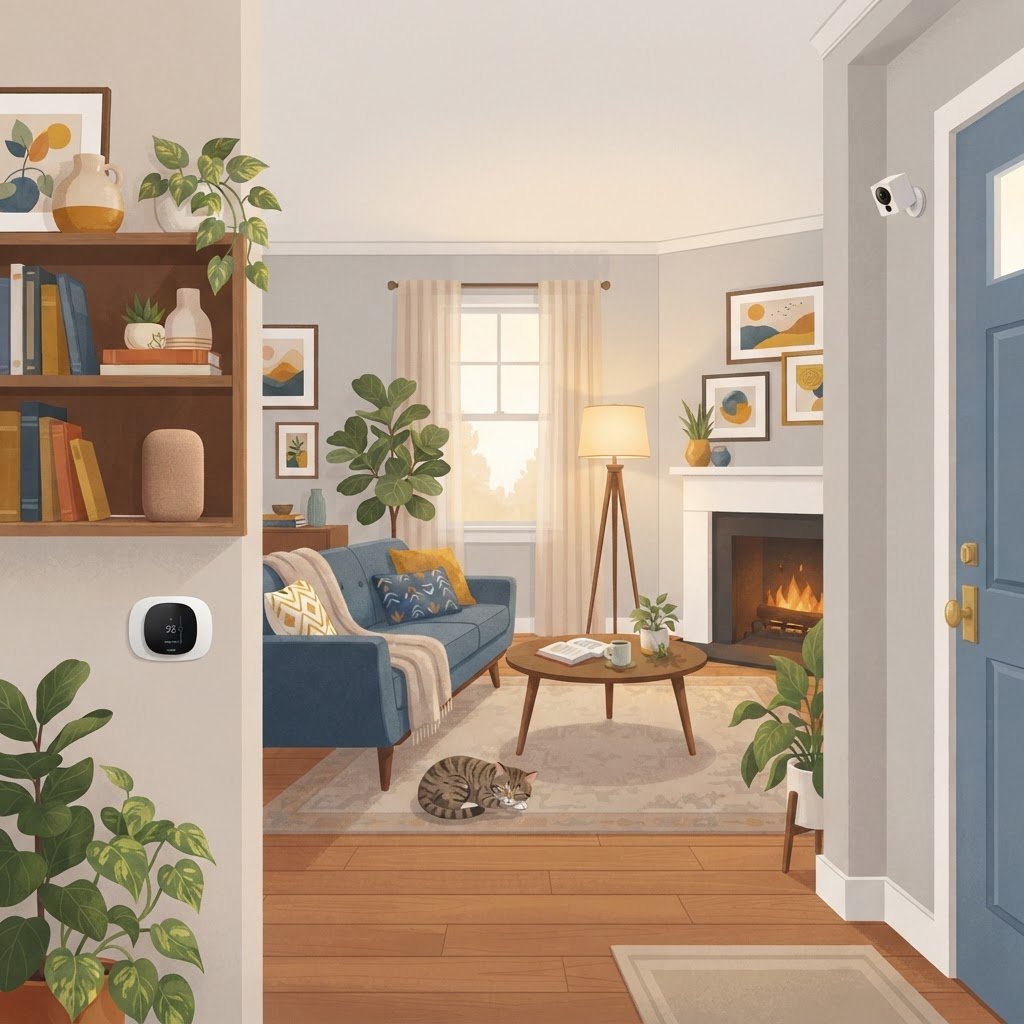
Let us start with what has genuinely changed. The most significant shift is one that most people take for granted now, which is itself a sign of success. Voice control has become boring. In the best possible way. Asking a speaker to turn off the lights, set a timer, or play a specific song has become so routine that it no longer feels like technology. It feels like talking to the house, and the house responding. This is the quiet victory of the smart home. The friction between intention and action has been reduced to near zero for a set of common tasks. According to data from Statista, smart speaker adoption in households has surpassed 40% in several developed markets, and the primary use cases remain remarkably consistent: music, timers, lighting, and weather. The simpler the task, the more durable the adoption.
Lighting has perhaps been the most successful category of smart home technology, and for good reason. The value proposition is clear, the installation is straightforward, and the daily benefit is tangible. Being able to adjust the colour temperature of lights throughout the day — warmer in the evening, brighter in the morning — is not a gimmick. It is a genuine quality-of-life improvement that people feel. The circadian rhythm lighting products that have emerged in recent years take this a step further, automatically shifting the light profile to align with natural daylight patterns. It is the kind of thing that sounds trivial until someone lives with it for a week and then cannot imagine going back.
Security is another area where the smart home has delivered on its promises, though not always in the ways that were predicted. The traditional alarm system, with its monthly monitoring fee and opaque installation process, has been largely supplanted by a combination of smart cameras, doorbell cameras, and motion sensors that homeowners can install and monitor themselves. The shift is significant. Where home security once required a professional and a contract, it now requires a few hours and a Wi-Fi connection. The footage quality, night vision capabilities, and person-detection algorithms have improved substantially. False alarms are less common than they were a few years ago, though they have not been entirely eliminated. The peace of mind that comes from checking a camera feed while away from home is something people genuinely value, and that value has driven adoption more than any marketing campaign could.
Energy management is the sleeper success story of the smart home. Smart thermostats were among the first connected devices to gain mainstream traction, and they have continued to improve. The current generation of thermostats does not just learn when someone is home or away. It integrates with weather forecasts, understands the thermal characteristics of the specific home, and can optimise heating and cooling schedules to minimise energy use without sacrificing comfort. In an era of rising energy costs and growing climate awareness, this practical benefit resonates. The savings are real. Multiple studies have confirmed that smart thermostats can reduce heating and cooling costs by 10-15% on average, which over a year adds up to meaningful money for most households.
Now for what has not changed, or at least has not changed as much as was promised. The smart refrigerator remains a cautionary tale. The idea of a fridge that tracks its own contents, suggests recipes based on what is inside, and automatically reorders groceries is appealing in theory. In practice, the technology has struggled with the messiness of real life. Refrigerators are opened and closed by multiple people. Items are moved, consumed, and replaced in ways that are difficult for cameras and sensors to track accurately. The result is a device that often has an incorrect inventory, which undermines the entire value proposition. People do not want a fridge that thinks they are out of milk when they are not. They want a fridge that works, and the current generation of smart fridges does not reliably do both.
The interoperability problem has also persisted longer than anyone hoped. The vision of a seamlessly connected home, where devices from different manufacturers communicate effortlessly, remains more aspiration than reality. There have been improvements. The Matter protocol, designed to create a universal standard for smart home devices, has gained traction and is supported by most major manufacturers. But the transition is ongoing, and many households still have a patchwork of devices that require separate apps, separate hubs, and separate accounts. The user experience of managing a fully smart home can feel less like living in the future and more like being an IT administrator for a very small office. This is not the seamless experience that was promised, and it remains a source of frustration for anyone who has invested deeply in the ecosystem.
The privacy conversation has also evolved in ways that were not fully anticipated. In the early days, concerns about smart speakers listening and cameras recording were largely dismissed by enthusiasts as overblown. In 2026, those concerns are taken more seriously, and the industry has had to respond. Device manufacturers have added physical microphone switches, local processing options, and more transparent data policies. But the fundamental tension remains. A smart home is, by definition, a home filled with sensors that collect data about the people living in it. The convenience is real, but so is the trade-off. People are making more informed choices now, which is a positive development, but the choices themselves have not become easier.
Perhaps the most interesting thing about the smart home in 2026 is what people have decided matters and what they have decided does not. The devices that have succeeded are the ones that solve a problem people actually have, and solve it reliably. The ones that have struggled are the ones that were technically impressive but practically unnecessary. A smart light switch that works every time is valuable. A smart toaster that connects to Wi-Fi to download firmware updates is not. The market has been a remarkably effective filter, and what remains is a set of technologies that have earned their place in the home through consistent usefulness rather than novelty.
The role of artificial intelligence in the smart home is also worth noting, because it has shifted from being a marketing buzzword to being a functional component. AI is not making homes sentient, but it is making them more efficient. The person-detection algorithms in security cameras are powered by machine learning. The learning capabilities of thermostats are AI applications, even if nobody calls them that. The voice recognition that makes smart speakers useful is fundamentally an AI technology. The difference between now and five years ago is that these applications have matured. They work well enough that people do not think about them, which is the highest compliment that can be paid to a technology.
Looking ahead, the smart home is likely to continue its quiet evolution rather than undergo another revolutionary moment. The devices that are already successful will get better. The ones that have struggled will either improve or disappear. The interoperability problem will gradually resolve as older devices are replaced with Matter-compatible ones. And the privacy conversation will continue to shape how products are designed and how people choose to use them. The smart home of 2030 may not look dramatically different from the smart home of 2026, but it will work better, more reliably, and with less friction. Sometimes that is the best outcome a technology can hope for. Not a revolution, but a gradual, steady improvement that makes daily life just a little bit easier. The smart home has not changed everything. But it has changed enough things, in enough homes, that it can no longer be dismissed as a fad. It has become, like so many successful technologies before it, boring. And boring, in the world of technology, is the highest praise there is.




