
A perspective piece from The Listening Market
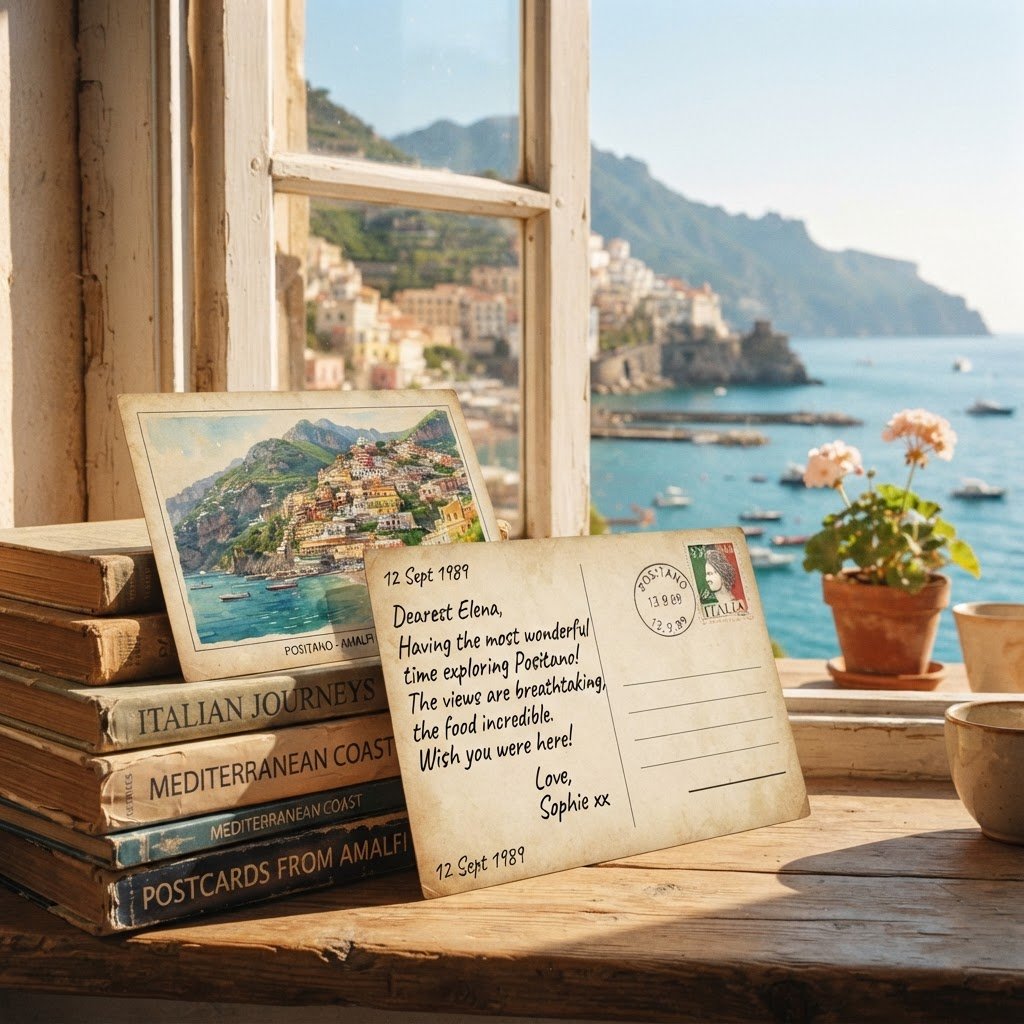
The postcard was supposed to be dead. It had been declared obsolete by the same logic that declared letter writing obsolete, bookstores obsolete, and the landline telephone obsolete. A photo sent from a phone was faster, sharper, and free. It could be shared with everyone at once. It arrived instantly. By every metric that mattered to a culture obsessed with speed, the postcard could not compete.
And yet, the postcard is back. Not in the volumes of its mid-twentieth-century heyday, and not with the same cultural ubiquity, but with a quiet, growing presence that has surprised the retailers who stock them and the travellers who send them. What was dismissed as a relic has found a second life, and the reasons for its return say something interesting about what people are looking for when they travel.
The difference between sending and sharing
A photo shared on social media is a broadcast. It goes out to everyone simultaneously, and it is consumed in the same way as everything else on the feed, quickly, without context, and alongside dozens of other images competing for the same few seconds of attention. The sender does not know who will see it. The viewer does not know who else is seeing it. The interaction is efficient, but it is also impersonal in a way that is rarely acknowledged.
A postcard is the opposite. It is addressed to one person. It travels through physical space, carried by hands and vehicles, and arrives at a specific place at a specific time. The recipient knows who sent it because the name is written on the back. The sender knows who will receive it because the address is written on the right. The transaction is private, deliberate, and bounded. It is a message from one person to another, and that is all it is.
This distinction matters because the value of communication is not always proportional to its efficiency. A text message saying “thinking of you” takes two seconds to send and is forgotten within a minute. A postcard with the same message takes days to arrive and is kept for years. The content is similar. The medium changes everything.
The slowness is the point
The postcard’s great disadvantage, its speed, is also its great advantage. A message that takes several days to arrive carries with it a different quality of intention than one that arrives instantly. The sender had to find a shop, choose a card, write on it, find a stamp, and locate a postbox. Each of these steps required a small but deliberate effort, and the effort is part of what the recipient receives.
When a postcard arrives, it represents not just a thought but a journey. It was written in a different place, under different circumstances, and it has travelled to reach its destination. The stamp bears the mark of a foreign postal system. The handwriting may be slightly uneven because the card was written on a café table or a park bench. These imperfections are evidence of authenticity, and authenticity is something that digital communication, with its uniform fonts and perfect reproduction, cannot easily provide.
The slowness also changes the content. When communication is instant, there is pressure to say something immediate and relevant. When communication is delayed by days, the message tends to be more reflective. The sender is not responding to a conversation but creating one. The words are chosen with more care, because they will stand alone, unaccompanied by the context that a real-time exchange provides.
The physical object as memory
A postcard is a physical object, and physical objects have a different relationship with memory than digital files. A photograph stored on a phone is one of thousands, and it is seen in the same context as every other image on the device. A postcard pinned to a refrigerator or tucked into a bookshelf is a single object in a specific place, and it carries its context with it.
People who receive postcards tend to keep them. They are displayed on kitchen walls, stuck to bulletin boards, and collected in boxes. Years later, they serve as triggers for memory in a way that digital images rarely do. The card is a relic of a specific trip, sent by a specific person, from a specific place, and its presence in the home is a small, persistent reminder of a connection that transcends the immediate moment.
This is not a romantic exaggeration. The psychology of memory is closely tied to physical cues. Objects that are associated with events become anchors for the memory of those events, and the more distinctive the object, the stronger the anchor. A postcard is distinctive by nature. It has a unique image, a unique handwritten message, and a unique provenance. It is a better memory trigger than a file in a cloud storage account, and it does not require a password to access.
The role of the postcard in modern travel
The return of the postcard is connected to broader shifts in how people travel. The trend toward slower, more intentional travel has created a context in which the postcard makes sense again. When the goal of a trip is not to see as much as possible but to experience a place more deeply, the act of sitting down to write a postcard becomes part of the experience rather than a distraction from it.
Writing a postcard forces a moment of pause. It requires the traveller to reflect on where they are and what they want to say about it, and this reflection is itself a form of engagement with the place. The five minutes spent writing a card in a square in Lisbon or a café in Hanoi are five minutes of being present in a way that taking a photo and moving on is not.
There is also a social dimension. The postcard is a way of maintaining a connection with people who are not on the trip, and it does so in a form that is more personal than a group message and more deliberate than a social media tag. The recipient feels considered, because the card was chosen for them, written for them, and sent to them. It is a small gesture, but small gestures are the fabric of relationships, and the postcard is a particularly durable one.
The postcard economy
The economic side of the postcard’s return is modest but real. Independent stationery shops, museum gift shops, and small bookstores have reported steady or increasing sales of postcards, particularly those featuring local art or photography rather than mass-produced tourist images. The postcard has become a small but meaningful revenue stream for artists and illustrators whose work is reproduced on them.
Postal services, which have been struggling with declining mail volumes for decades, have benefited from the return as well. The volume is not enough to reverse the broader trends, but it represents a category of mail that is growing rather than shrinking, and that has a demographic profile that skews younger than the traditional letter-writing audience.
The postcard rack, once a ubiquitous feature of every tourist destination, had largely disappeared from many places. It is reappearing, though in a different form. The new postcard racks tend to be more curated, featuring the work of local artists rather than generic landscape photographs. The postcard has been重新 position, not as a cheap souvenir but as a small piece of art that happens to be functional.
What the postcard knows that the phone does not
The postcard’s return is not a rejection of digital communication. Nobody is suggesting that people should stop sending photos from their phones or that social media has no place in travel. The postcard is returning because it does something that digital communication does not, and the something is related to the qualities that make physical objects meaningful.
A postcard is intentional. It cannot be sent by accident or by habit. It requires a choice, an effort, and a delay, and each of these adds a layer of meaning that instant communication strips away. It is a small object that carries a large message, which is simply that someone, somewhere, was thinking of a specific person and took the time to say so in a way that could be touched and kept.
The postcard knows that the most valuable communications are not always the fastest ones. It knows that a message worth sending is worth the trouble of sending. And it knows, with the quiet confidence of an object that has outlasted every prediction of its demise, that some forms of connection are too meaningful to be replaced by efficiency. The postcard is back because people are rediscovering that the medium is part of the message, and that a piece of cardboard with a stamp and a few handwritten lines can say more than a perfectly composed photo ever could.




