
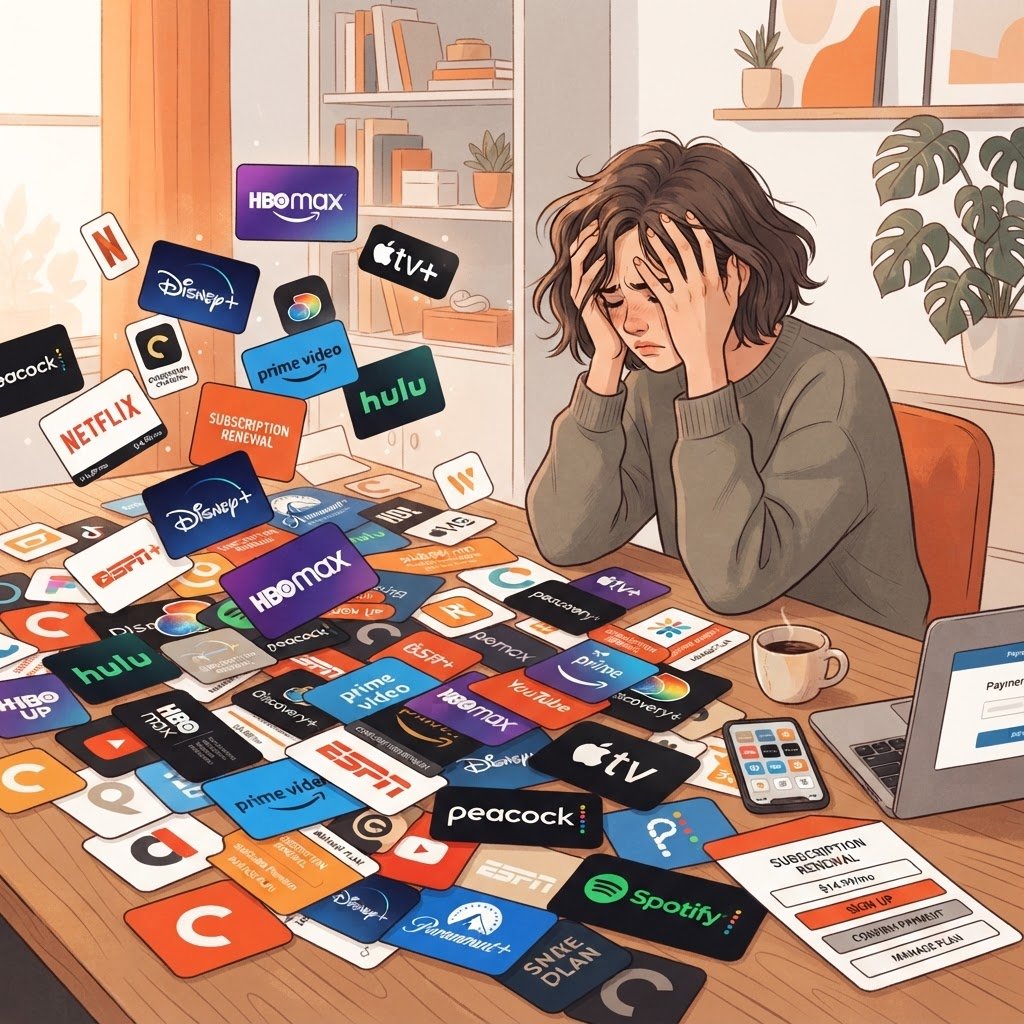
A perspective piece from The Listening Market — The contemporary digital landscape was built on a remarkably enticing premise: total convenience at a fraction of the traditional cost. With a simple tap on a screen or a brief checkout process, individuals gained instant access to vast catalog libraries of music, cinematic entertainment, professional design software, cloud infrastructure, news publications, fitness coaching, and even artisanal physical goods delivered directly to the doorstep. What initially arrived as an elegant solution to physical clutter, expensive software licenses, and heavy upfront capital investments has gradually transformed into a pervasive, quiet form of financial and cognitive fragmentation. Across the global market, the steady cultural migration from permanent asset ownership to recurring monthly access was initially hailed as consumer liberation. Households no longer needed to purchase expensive physical media boxes, buy permanent desktop software licenses, or lock themselves into multi-year service contracts. The digital revolution promised infinite variety, automatic background updates, and complete personal flexibility without the long-term commitments of the past.
Yet, over the past decade, these unassuming monthly transactions—frequently individual line items ranging from four dollars and ninety-nine cents to nineteen dollars and ninety-nine cents—have silently aggregated into a formidable secondary financial obligation. What originally felt like negligible micro-payments now compound across credit card statements every single month like a silent tax on modern life. From video streaming networks and audio streaming services to cloud backup storage, digital newspaper subscriptions, fitness tracking applications, productivity tools, meal delivery passes, and specialized mobile software, the subscription business model has systematically embedded itself into nearly every facet of commerce. The fundamental dilemma confronting contemporary consumers is no longer a question of what services exist, but rather how many recurring commitments a single life can sustain before convenience disintegrates into overwhelming subscription fatigue.
The Architecture of Psychological Inertia
The staggering financial success of the subscription economy relies heavily on a nuanced understanding of behavioral economics and cognitive bias. When a substantial annual expense is dismantled into small, recurring monthly payments, the human brain evaluates the commitment through a fundamentally different decision-making framework than a traditional single purchase. A two-hundred-dollar annual software license or a major upfront hardware investment naturally triggers a deliberate pause for thought. It demands budget evaluation, comparison shopping, and a rigorous assessment of long-term personal utility. Conversely, a recurring monthly charge of nine dollars and ninety-nine cents slides seamlessly beneath the threshold of active financial defense. The individual amount appears small, manageable, and virtually insignificant within the context of total monthly household expenditure.
Furthermore, subscription models are explicitly designed to leverage psychological inertia. Once payment credentials are stored within a billing system and automatic renewal is toggled on, the default consumer posture shifts from active choice to passive continuation. Canceling a service requires deliberate friction: navigating multi-layered account settings, recalling forgotten login passwords, sitting through exit surveys, and declining defensive discount offers engineered to stall cancellation. Sourced from a 2024 consumer study conducted by C+R Research, findings revealed that consumers underestimated their monthly subscription expenditure by an average of $133 per month, vividly demonstrating how effectively recurring charges fade into the background of daily financial awareness. A separate industry report published by West Monroe found that over 80 percent of surveyed consumers underestimated their total recurring payments, proving that digital subscription charges operate largely in an environment of collective oversight and administrative friction.
Content Fragmentation and the Illusion of Abundance
In the foundational era of digital streaming and software-as-a-service platforms, market consolidation offered undeniable value. A single major streaming service or unified software suite satisfied almost every entertainment or professional requirement, delivering vast content selections at a stable, highly predictable price. However, as the immense profitability and Wall Street valuation multiples of recurring revenue streams became clear across every corporate sector, media conglomerates, software publishers, and niche creators rushed to build proprietary subscription environments. The unified digital marketplace rapidly fragmented into dozens of competing walled gardens, each asserting exclusive rights over specific catalog assets and demanding an independent monthly tribute for access.
The direct result of this aggressive market expansion has been severe content fragmentation. A film enthusiast seeking to keep pace with modern cinema now discovers that critical movies and series are scattered across half a dozen separate streaming services, with licensing agreements shifting unpredictably between platforms from month to month. Similarly, an independent designer or small enterprise operator must navigate distinct monthly plans for vector illustration, layout editing, typography libraries, asset backup, document authorization, and team messaging tools. Far from simplifying daily life, the modern subscription matrix has multiplied friction. The simple act of watching a specific documentary or completing a routine creative workflow now involves searching through multiple paywalls, resolving tier restrictions, and managing multiple user accounts.
As cited in Deloitte’s 2024 Digital Media Trends survey, nearly half of consumers expressed significant frustration over the growing number of separate subscriptions required to access desired media, leading an increasing proportion to actively churn, cancel, or rotate services in response to market oversaturation. The promise of infinite digital abundance has paradoxically yielded a landscape of administrative complexity, where accessing desired content requires managing a web of recurring financial commitments.
The Cognitive Overhead of Perpetual Rental
Beyond the measurable impact on personal financial balances, subscription fatigue imposes a subtle yet persistent drain on mental clarity and personal attention. Unlike physical clutter, which manifests visibly inside a room and provides a natural prompt for decluttering when physical space becomes overcrowded, digital subscriptions remain largely invisible. They hide within automatic email notifications, buried banking line items, and remote account dashboards, lingering quietly in the background of consciousness as unfulfilled obligations.
Every active recurring service carries an implicit psychological demand: the lingering pressure to justify the recurring expense through active usage. An unread digital journalism subscription, an underutilized online masterclass platform, a specialized fitness application, or an auxiliary streaming account can easily transform from a source of personal enrichment into a subtle source of recurring guilt. Leisure activities begin to resemble mandatory obligations as individuals feel compelled to consume media or run applications simply to recoup the financial value of an automated monthly charge.
Furthermore, the fundamental transition from ownership to perpetual rental alters the human connection to culture, tools, and media. When nothing is owned outright, access remains permanently conditional—subject to unexpected subscription price hikes, tier demotions, content purges, or platform shutdowns. The modern consumer exists in a state of permanent tenancy, paying indefinitely for access that can be altered, restructured, or revoked at the provider’s discretion.
The Corporate Mechanics Driving Recurring Revenue
To understand why subscription fatigue has reached a tipping point, consideration must be given to the corporate incentives driving the broader economy toward recurring billing models. From an institutional finance perspective, predictable annual recurring revenue represents the premier corporate metric. Wall Street analysts and private equity investors reward recurring subscription revenues with significantly higher valuation multiples than traditional transactional product sales, because recurring billing creates highly predictable cash flows and elevates customer lifetime value over extended horizons.
However, this corporate incentive structure frequently creates a structural alignment problem between the vendor and the consumer. Once a business model prioritizes retention metrics and subscription volume over individual product purchases, product development often shifts toward maintaining platform lock-in rather than delivering breakthrough standalone value. Price increases become a systematic strategy to drive corporate top-line growth when initial user acquisition reaches saturation across key demographics.
In recent years, streaming platforms and software developers have systematically increased monthly rates, introduced ad-supported base tiers while pushing ad-free access into premium price brackets, and restricted password sharing across households. For the consumer, this manifests as a steady degradation of value: paying higher monthly fees for the same or lesser service features that were once included in standard plans, compounding broader economic pressures during periods of general household inflation.
Strategic Audit: Modern Methods for Subscription Management
Addressing subscription fatigue does not require a complete withdrawal into digital isolation or a dogmatic rejection of valuable modern tools. Instead, it calls for a deliberate return to conscious consumption and structured financial management. Countering the subtle creeping expansion of monthly commitments requires establishing proactive habits that restore personal control over recurring expenditures.
The most effective starting point is a comprehensive financial and digital subscription audit. Bringing hidden recurring charges out of the ambient background and into sharp focus allows individuals to evaluate each service based on true utility rather than vague future intention. Reviewing bank and credit card statements over a full twelve-month window often reveals legacy software plans, forgotten free-trial conversions, or duplicate utilities that continue to draw funds automatically. Categorizing these recurring charges into essential utilities, high-value professional tools, and optional entertainment services provides immediate clarity on where financial resources are actually flowing.
Beyond the initial audit, adopting a flexible rotational subscription model offers a practical strategy for managing entertainment and media platforms. Rather than maintaining continuous subscriptions across multiple video streaming services simultaneously throughout the year, consumers can choose to activate a single service for a focused thirty-day period to view specific programming, canceling immediately after activation so the service automatically expires at the end of the term. This rotational practice restores intentionality to viewing habits while keeping total monthly expenditures strictly bounded within a designated allowance.
Rediscovering Alternative Ownership and Intentional Limits
In parallel with rotational habits, exploring non-subscription alternatives offers an effective remedy for subscription fatigue. The modern digital landscape contains numerous powerful open-source software applications, perpetual-license creative tools, and independent utilities that operate without recurring fees. Evaluating single-purchase software options, supporting independent developers who offer traditional one-time licensing, and utilizing physical media or local public library digital resources reintroduces stability, true ownership, and long-term financial predictability into daily living.
Furthermore, setting strict personal limits on total active subscriptions creates a natural constraint against impulse sign-ups. Establishing a personal ceiling—for example, limiting non-essential recurring services to a maximum of three active platforms at any given time—forces a direct trade-off whenever a new service is considered. If a new platform promises genuine value, an existing subscription must be retired to make room, preventing the gradual accumulation that leads to fatigue.
Ultimately, subscription fatigue is a healthy cultural response to a commercial environment that has pushed recurring monetization to its logical extreme. By reclaiming agency over monthly expenditures, rejecting automatic renewals as the default state of living, and insisting on intentional value in exchange for recurring capital, consumers can clear away digital clutter, reduce financial stress, and cultivate a far more satisfying, purposeful relationship with the modern media and software tools they choose to employ.