
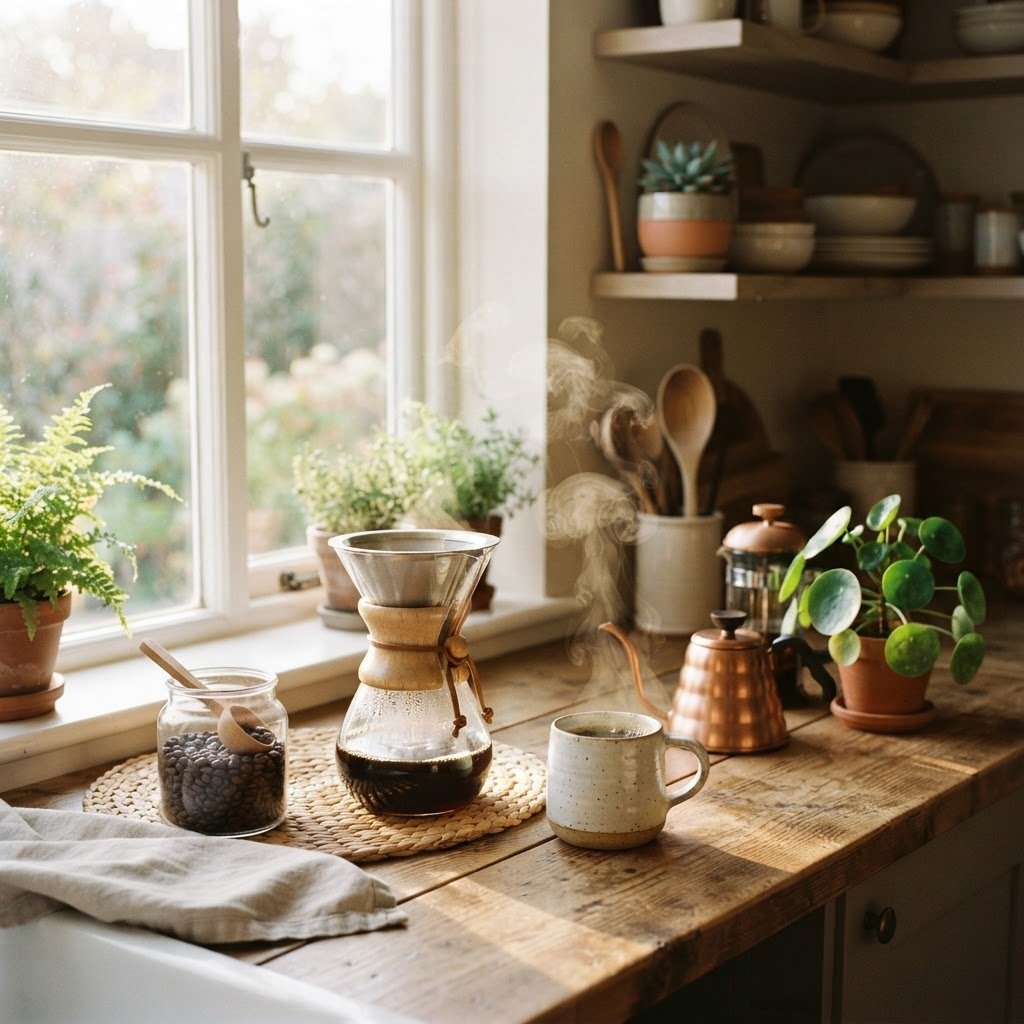
A perspective piece from The Listening Market
There is a particular sound that has begun defining mornings in homes across the country. It is not the sharp beep of an alarm clock or the clatter of a rushed school run. It is the low, steady grind of coffee beans meeting burrs, followed by the slow, almost meditative pour of water over freshly ground beans. The kitchen, once a place of speed and function, has become something else entirely. It has become a café.
The rise of home café culture is not simply about coffee, though coffee is its beating heart. It is about a broader shift in how people are choosing to start their days, how they are reclaiming small pockets of pleasure from schedules that once felt entirely out of their control. What used to be a transaction, a few dollars handed across a counter for a paper cup, has become a ritual. And that ritual is reshaping the way people think about their homes, their mornings, and themselves.
## From Convenience to Craft
For years, the morning coffee run was a symbol of modern busyness. It was efficient, transactional, and oddly impersonal. The barista knew the order, maybe the name, but the exchange was over in under ninety seconds. The coffee itself was often consumed in a car or at a desk, barely tasted. Somewhere along the way, the coffee stopped being an experience and became fuel.
The shift back toward craft began quietly. A pour-over kettle here, a modest espresso machine there. Suddenly, kitchens were being rearranged to accommodate scales and tampers. People who once could not tell a Robusta from an Arabica were learning about bloom times and extraction ratios. The language of specialty coffee, once the preserve of hipster cafés and roasteries, had entered the domestic sphere.
What drove this was not just a desire for better coffee, though that was certainly part of it. It was a desire for something slower, something that could not be rushed. In a world where most tasks can be automated, delegated, or skipped entirely, the deliberate act of making coffee by hand became a small act of resistance against the cult of efficiency.
## The Equipment That Changed Everything
The democratisation of café-quality equipment has been central to this movement. A decade ago, a decent espresso machine was a luxury item, often costing thousands and requiring the kind of counter space most kitchens could not spare. Today, the landscape looks entirely different. Compact espresso machines, capable of producing shots that would satisfy most café standards, sit alongside toasters and kettles in kitchens across the country. Manual brewing devices, from French presses to Aeropresses to Chemex carafes, offer entry points at every budget.
The second-hand market has played its part too. Marketplaces are flooded with barely used grinders and machines, bought with enthusiasm and sold when someone upgraded. This has created a tiered ecosystem where beginners can start with a modest investment and gradually refine their setup as their skills, and their palate, develop.
Social media has accelerated the trend. The aesthetic appeal of a well-arranged coffee station, complete with matching canisters and a dedicated knock box, has become a genre unto itself. But beneath the surface-level appeal of an Instagram-worthy bench, there is something more substantive happening. People are learning. They are watching tutorials, reading about origin countries, and engaging with coffee in a way that goes beyond consumption.
## The Psychology of the Morning Ritual
The appeal of home café culture is not purely about taste or aesthetics. There is a psychological dimension that explains why so many people have gravitated toward this particular ritual. The morning coffee, when made at home and made with intention, becomes what psychologists might call an anchor habit. It is a predictable, controllable moment in a day that often feels anything but.
Research into habit formation has long highlighted the power of routines in reducing cognitive load. When the first twenty minutes of the day follow a familiar pattern, the brain does not have to make decisions before it is fully awake. The grinder goes on, the water is heated to the right temperature, the pour begins. Each step is a small signal to the body and mind that the day has begun on the right terms.
This is fundamentally different from the experience of grabbing a coffee on the way to work. That version of the morning is reactive, shaped by traffic, queue lengths, and the mood of whoever happens to be behind the counter. The home café, by contrast, is proactive. The person making the coffee is in control of every variable, from the grind size to the water ratio to the time they take to drink it.
## The Economic Case
The financial argument for home café culture is straightforward, though it is rarely the primary motivation. Even a relatively expensive home setup, one that includes a quality grinder and a capable espresso machine, pays for itself within a year for someone who was previously buying a café coffee every weekday. The maths is simple enough that it barely needs spelling out, and yet the economic dimension is almost a footnote in the broader story.
What people are paying for when they invest in home coffee equipment is not just savings. They are paying for the experience itself. They are paying for the ability to make something good, repeatedly, in a space that is entirely their own. The cost of a bag of specialty beans, which might seem high compared to supermarket coffee, is negligible when measured against the cost of a month of café visits. And the quality, for someone who has invested time in learning technique, often surpasses what is available at the average high-street café.
## Beyond Coffee
Home café culture has begun to extend beyond coffee itself. The same impulse that drives someone to perfect their espresso shot is leading others to explore tea ceremonies, matcha preparation, and even the art of making hot chocolate from scratch. The kitchen bench, once a place of reheating and assembling, is becoming a space of genuine creation.
This broader trend reflects something important about the current moment. After years of outsourcing daily tasks to apps and services, people are rediscovering the satisfaction of doing things themselves. Not everything, and not all the time, but enough to feel a sense of agency over the small rhythms of daily life. The home café is a manifestation of this broader reclaiming, a way of saying that not every moment of the day needs to be optimised for speed.
## A Social Shift
The home café has also changed the way people socialise. Inviting someone over for coffee, once a casual afterthought, has taken on a new weight. It is now an opportunity to share something crafted, to demonstrate a skill, and to create a moment of genuine hospitality. The living room has ceded some of its social primacy to the kitchen, where guests can watch the process and be part of it.
This is not a return to some idealised past. The home café of 2026 is not a recreation of a 1950s kitchen. It is something new, shaped by global coffee culture, by online communities, and by a genuine desire for slowness in a fast world. It is, in many ways, the perfect response to the exhaustion of always being available, always connected, always on. A cup of coffee made at home, made well, and made with care, is a small declaration that some things are worth doing properly.
## The Quiet Revolution
The rise of home café culture is unlikely to reverse itself. Once someone has experienced the satisfaction of making a genuinely good cup of coffee in their own kitchen, the idea of paying five dollars for a mediocre one becomes less appealing. Cafés will not disappear, of course. They serve a different purpose, offering space, atmosphere, and the convenience of someone else doing the work. But the home café is carving out a distinct and durable place in daily life.
What started as a lockdown-era hobby for many has become a permanent fixture. The equipment is in place, the skills are developing, and the ritual is established. The morning grind is no longer something to be endured. It is something to be savoured.




