
A perspective piece from The Listening Market
The image of the successful business used to be straightforward. An office, a team, a hierarchy of roles and responsibilities spread across multiple people. Growth meant hiring. Scale meant headcount. The logic was so deeply embedded in how business worked that it barely needed stating. To do more, you needed more people. To compete, you needed a team that could match the output of whoever you were up against. One person could start something, but they could not run it, not at any meaningful scale, not without help.
That assumption is being quietly dismantled. Across industries, from consulting to design to software development to content creation, individuals are building businesses that generate the output of small teams without employing a single person. They are not freelancers in the traditional sense, trading time for money on a one-to-one basis. They are operators, founders of companies that happen to have a staff of one, and they are increasingly outperforming small teams not despite their size but because of it.
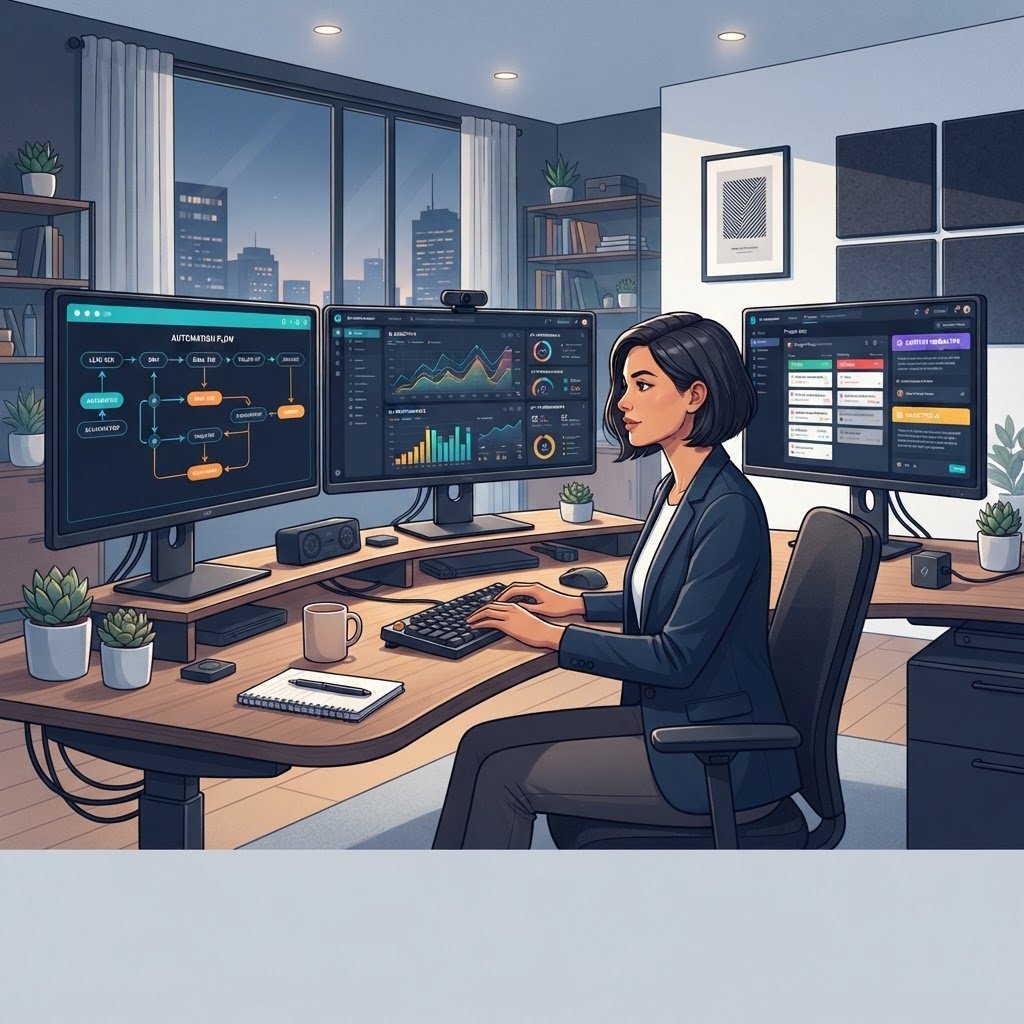
The driver behind this shift is the maturing of a set of tools that, taken together, have effectively given a single person the leverage of an entire department. AI-powered writing assistants can draft marketing copy, customer emails, and proposals in minutes. Design tools can generate professional visuals from a text description. Accounting software automates invoicing, expense tracking, and tax preparation. Customer relationship management systems, once the domain of enterprises with dedicated sales teams, are now available as lightweight applications that a single user can configure in an afternoon. The solopreneur does not need to be an expert in each of these domains. They need to be a competent orchestrator of the tools that handle them.
What this means in practice is that the traditional overhead of running a business, the salaries, the office space, the management layers, the meetings about meetings, has been dramatically reduced. A solopreneur with the right tool stack can handle client communication, project delivery, marketing, and financial administration in a fraction of the time it once took. The hours that a small business owner once spent managing employees can instead be spent serving clients or developing new offerings. The capital that would have gone to payroll can be reinvested in better tools or simply kept as profit.
The advantages extend beyond efficiency. A one-person business has an inherent agility that larger operations struggle to match. When a client needs something done differently, the solopreneur simply does it differently. There is no chain of command to consult, no team to realign, no internal politics to navigate. Decisions are made in real time, by the person doing the work, with full knowledge of the client’s needs and the project’s context. This responsiveness is not just a convenience. It is a competitive advantage that clients are increasingly willing to pay for.
Consider a small marketing agency with five employees and a solopreneur offering similar services. The agency has more raw capacity, more specialist skills, more hands on deck. But it also has coordination costs. Briefings need to be written. Work needs to be delegated and reviewed. Miscommunications need to be unwound. The solopreneur, working alone with AI tools, can often move from client request to delivered work in a single session. The agency may produce a more polished final product, given enough time, but the solopreneur can iterate faster, communicate more directly, and adjust course without the friction of team dynamics. For many clients, particularly small and medium-sized businesses that value speed and direct communication, the solopreneur model is not just adequate. It is preferable.
The economics are striking. A solopreneur charging professional rates, with minimal overhead, can achieve profit margins that a traditional small business simply cannot match. There is no payroll to fund during lean months. There are no underutilised employees sitting idle between projects. Every hour of work translates directly to revenue, and every tool subscription is a fraction of the cost of a part-time salary. The result is a business that is not only leaner but more resilient, able to weather downturns without the crushing weight of fixed labour costs.
This is not to say that the solopreneur model is without limitations. There is a ceiling to what one person can produce, even with excellent tools. Complex projects that require multiple parallel workstreams, or clients that demand round-the-clock availability, can strain a single operator. There is also the question of specialisation. AI tools can produce competent work across many domains, but deep expertise in a specific area still requires human experience and judgement. The solopreneur who tries to be everything to everyone risks mediocrity across the board.
The most successful solopreneurs tend to be those who have identified a narrow, valuable niche and built their entire operation around serving it exceptionally well. They are not generalists. They are specialists who use tools to handle the generalist work that surrounds their core competency. A copywriter who uses AI to handle administrative tasks but writes the key client deliverables personally. A designer who uses AI for research and ideation but crafts the final designs by hand. A consultant who uses automation for reporting and scheduling but brings deep industry knowledge to the actual advisory work. In each case, the human is the irreplaceable element, and the tools are the support structure that allows them to operate at a scale that would once have required a team.
The cultural shift that accompanies this economic one is significant. For decades, business success has been measured in part by team size. How many people do you employ? was a proxy for how successful you are. The solopreneur movement challenges this metric directly. A business with no employees can be more profitable, more agile, and more satisfying to run than one with ten. The status symbol of a large team is being replaced by the status symbol of a lean, profitable, self-sufficient operation. Growth is no longer automatically associated with hiring. It is associated with capability, with the ability to take on more or better work without proportionally increasing costs or complexity.
The psychological dimension of running a business alone is complex and often misunderstood. There is a common assumption that working alone means being lonely, and for some solopreneurs this is a genuine challenge. The absence of colleagues to bounce ideas off, to share frustrations with, to celebrate small wins alongside, can create a sense of isolation that erodes motivation over time. But the solopreneur community has responded to this with its own infrastructure. Online networks, coworking spaces, and mastermind groups provide connection without the commitments of employment. The solopreneur can choose when and how to engage with others, rather than being required to share space and attention eight hours a day with people they did not select.
There is also the matter of identity. In a culture that often defines professional success by the size of the operation a person oversees, the solopreneur must be comfortable with a different kind of status. They are not a CEO in the traditional sense. They do not manage people or build organisational charts. Their success is measured not in headcount but in output, reputation, and financial results. This requires a degree of self-assurance that not everyone possesses. The person who needs external validation in the form of a growing team and a corner office may find the solopreneur life unsatisfying. But for those who measure success by autonomy, mastery, and profit, the model offers a kind of freedom that traditional business structures struggle to provide.
This has implications for the broader economy. If more businesses can operate profitably at the scale of one person, the traditional employment relationship may become less central to how work is organised. Not everyone wants to be a solopreneur, and not every business can function as one. But the existence of a viable, attractive alternative to the traditional small business model expands the range of choices available to people with skills and ambition. It creates a path that does not require capital, does not require employees, and does not require giving up the craft of the work to become a manager.
There is also a quality-of-life dimension that should not be overlooked. The solopreneur has complete control over their schedule, their work environment, and their client list. They can choose to work intensely for three days and take four off. They can work from home, from a cafe, from a different city each month. They can say no to clients they do not want to work with. This autonomy, long the promise of entrepreneurship but often undermined by the responsibilities of managing a team, is more fully realised in the one-person model. The business serves the person, rather than the person serving the business.
The tools will continue to improve. AI capabilities that currently require human oversight will become more autonomous. Tasks that now take minutes will take seconds. The gap between what one person can do and what a small team can do will continue to narrow. At some point, the question may flip entirely. Rather than asking why someone is running a business alone, the more relevant question may become why anyone would choose the overhead, complexity, and risk of building a team when the same results can be achieved without one.
For now, the solopreneur is not replacing the small business. But the solopreneur is proving that the small business, as traditionally conceived, is no longer the only way to build something substantial. One person, the right tools, and a clear sense of what they do best. It is a simple formula, and it is quietly reshaping what a company looks like. The future of business may be smaller than anyone expected, and more capable than anyone imagined.




